Showing posts with label watercolours. Show all posts

Wednesday, July 8, 2015

Documentation, weeks 15-18: Notes for 'Have you ever...'

My ongoing interest in the Seralini Affair.

Work in progress…

The original rat images
The first sketch


The paper that I initially began using (above) was printmaking paper, not watercolour paper. So the colours wouldn't lift back off the page when water was re-applied. When I realised this I had to start again. (You can see the brush strokes are sketchy - I was trying to paint the colours separately in flicks of fur, that I thought would blur together when washed over with water afterwards. Didn't happen.) 
Round two:


The finished outcome

Some of the ideas going on:
Watercolour illustrations = associated with stories for children. I think that anthropomorphic animals in stories send mixed messages to children from a young age, implying some confusing double standards about animal welfare.

The title of this painting connects it to the nursery rhyme: 'Have you ever seen such a thing in your life... as three blind mice', as well as referencing the importance of scepticism towards scientific studies. Have you ever seen such a thing in your life? Really? Have you ever developed a giant tumour from eating popcorn? Know anyone who has? Could people really get cancer from eating GM corn? (Also, perhaps, blindness = metaphor for consumer helplessness, guinea pigs subject to corporate interests, unable to know what we're really consuming, as Seralini puts it 'eating in the dark'.) It touches on the circulation of misinformation regarding health science.

Monsanto's GM corn was not properly tested before being grown for commercial use. The lab rats in their experiments were only observed for 3 months, and even in that time there were some dubious results. They were, however, awfully quick to shoot down Seralini's research, even though the duration of his study was 8 times longer than theirs. The product went straight to market without proper testing. It's as if people - consumers - are the guinea pigs.

The thing that interested me the most about the Seralini affair was my observation that these lab rats, that had been fed GM corn (and RoundUp) and developed giant tumours, actually end up looking a bit like popcorn themselves. They've 'popped' just like the GM corn they are fed. You are what you eat??

The rats are life-sized, surrounded by larger-than-life size popcorn kernels - in this way size itself is also reference to genetic modification (and the idea of making things bigger.) As if the rats themselves are just pieces of popcorn.

Popcorn is a symbol for multiplicity; with that in mind, rats and other rodents are pests that breed and spread like the plague, spreading disease. It makes a connection that I see as fundamentally important part of my project: finding similarities between GMOs and introduced pests. And making the point that they don't belong in NZ.

It's also partially inspired by my part-time job at a cinema, which involves cleaning up a LOT of popcorn all the time. No one would ever eat this popcorn - it looks like it's in the bin (where else would you find rats?) so it references the problem of food waste. As well as the holocaust-esque disposal of sentient beings that is animal testing itself.

Why watercolours?
I've been trying to use watercolours for subjects that are appropriate to its unique traits - e.g. its 'lightness' is ideal for popcorn; 'fluffy' edges are the perfect technique for animals fur. I'm a painter so I appreciate the bleeding of paint across wet paper to create seamless tonal gradients without blending. And that, however deliberate a mark, there is an element of unpredictability, and seeing how pigments react with each other and dry often feels like a science experiment - which is, again, relevant to the subject here.

I wanted to make a watercolour painting that doesn't just float in the middle of the page. Hence a field of popcorn that reaches - and reaches past - the edges of the frame. It could be on the ground, could be a wallpaper, but either way it implies a wider extended pattern, a wider problem. Lots of them.

Documentation week 15-18: Notes and working images for 'Oma, oma, oma'

Making a cast paper sculpture isn't as simple as paper maché. Unfortunately.


Symbolism
-I'm interested in rabbits for many reasons. In NZ especially they represent introduced species gone wrong; they are simultaneously seen as a pest, a food, a pet, a material (rabbit skin glue is often used to size artist paper or prime canvases; rabbit fur and leather in clothing), a test subject, and a common (and often anthropomorphic) character in children's fiction. They also represent sex (playboy) and fertility; have strong connections with the moon - the markings on the moon depict a rabbit shape, hence the Moon Rabbit in Asian folklore, often seen with a mortar and pestle, in Japan it is said to be making 'mochi' rice cakes; in Christianity there is the recurring Three Hares symbolism, 3 rabbits and 3 ears, referencing the Holy Trinity (articles here and here); then there's the Easter bunny, associated with eggs & chocolates, which perhaps even begins to reference commercial/consumer culture childhood obesity… 
There's also slightly autobiographical element to this interest. I've always felt an affinity with rabbits. Until I had braces I always had 'rabbit teeth'. For me they also represent being Pakeha... an (unwanted?) introduced species in Aotearoa, now overrun and ravaging the land… I'm a bit tentative about that metaphor, though, as I don't want my art to be directly about race.
In any case rabbits are clearly very rich in meaning. But this doesn't stop them from being a huge problem here in NZ.


Materials
-I kept my notes and course book from my summer school paper, Maori 101, with vague intentions of recycling the paper somehow this year. I particularly wanted to make a work that referenced my [small amount of] maori heritage or perhaps just the experience of learning the language.

-I found a model rabbit in the toy section of Whitcoulls on Queen St during its closing down sale. This context made me think about the link between rabbits and children's literature...
-Peter Rabbit - Beatrix Potter
-The White Rabbit in Alice in Wonderland
-Watership Down
-There is also connection here with watercolours, so frequently used for children's books' illustrations, and famously used for Durer's 'Young Hare' painting.


Last year, I made a lot of recycled paper, including a couple of thick, moulded 3D works - just simple fruit bowls and pots for plants, made entirely of paper pulp. These rabbits were made using a similar process. However, with the bowls/pots the wet pulp was applied to the outside of the mould, and with the exposure to the air they dried within a few days. Anyway, I wondered if I could do something similar with a more complex shape.

On another note, when I tried to paint with watercolours on my handmade paper, I found that it disintegrated. Ellen Portch explained to me that paper needs a sizing agent and a common way to size artist-grade watercolour paper is with rabbit skin glue. The ball started rolling...

Process

Firstly, the rabbit from Whitcoulls was covered in layers of liquid latex. 


When dry, this was peeled off. The latex mould was filled with paper pulp, which had been sized with rabbit skin glue, pressed into the sides, and left to dry…
For two weeks.
But it was still damp inside the mould. So of course it fell apart when it was peeled off.

Take 2. I thought of cutting it in half to make two 'shells' that could be filled and left open to the air to speed up the drying process. It would just need some sort of support, a way to keep its form. Greg suggested we make a secondary cast like so, and cut it in half:


Except when we cut into it, it cracked into too many pieces to be of use. So we did a traditional plaster cast of the latex rabbit. The latex was cut in half, filled with pulp, most of the liquid pressed out then, then fitted into the plaster cast and left to dry.
And it worked!


The only complication was piecing the two paper 'shells' back together along the seam line, using more wet pulp, and re-drying. This led to noticeable differences in the resulting size and shape of the paper sculptures.

I wanted to paint some watercolours on them to enter them into the Henrietta and Lola Anne Tunbridge scholarship. The eyes were enough. Luckily as the paper was sized with rabbit skin glue I could paint on it without too much bleed. (There was a bit of bleeding, but this is interesting in itself - it speaks to the idea of animal testing, maybe.)

Some photoshopping to decide how the eyes would be painted:


The title...

'Oma, oma, oma' is a reference to the Maori song kiwi kids all learn in primary school: Oma rapeti, oma rapeti, oma, oma, oma. Run rabbit, run rabbit, run, run, run. 
It's a cute song. Also maybe a bit sinister? At least I think so. Run, rabbit run: from the scientists who will use you as a test subject; the farmers and hunters who will shoot you and eat you for dinner; the artists who will use your skin for glue; the designers who will use your skin and pelt for leather bags and fur clothing; even the loving families who will keep you in a cage for the rest of your life. 
So for me this title links the subject to the material (recycled paper from Maori 101) and the 'children's literature' connections, and the triptych, the idea of multiplicity. 

Documentation Weeks 15-18: 'Oma, oma, oma'

Oma, oma, oma
Watercolours on cast recycled paper


Tuesday, July 7, 2015

Documentation weeks 15-18: 'For One'

For One
Watercolours on paper, 33x49cm

Documentation weeks 15-18 'The Colonel'

While painting the large-scale watercolour of popcorn, and going slightly mad in the process, I kept finding what looked like morbid faces in the shapes of the kernels. I got thinking about the implications of this - a bizarre but possibly interesting juxtaposition? - and the possibility of referencing vanities with popcorn. This idea also led me to this antiquated website: Popcornface, and I knew I had to do it.
The image below was made by combining skull-like elements from different kernels. However the result is still not as subtle as I would like it, so I might try again... but probably not. On reflection I feel like using an image of a skull oversimplifies the ideas I'm interested in. Skulls generally imply "X=inevitable death" and I'm much more interested in the complexities, complications, misinformation etc of food systems.


Documentation weeks 15-18 'Have you ever seen such a thing in your life'


Have you ever seen such a thing in your life
Watercolours on paper, 55x73cm

Notes and working images here

Monday, July 6, 2015

Documentation: Weeks 15-18 'Bio In Security'


Bio In Security
Watercolour on paper, 55x73cm

Notes from my application for the Henrietta and Lola Ann Tunbridge watercolour scholarship:

'Delicate' and 'detailed' - not necessarily qualities which are encouraged in a contemporary art environment, but they certainly explain why watercolours are my go-to medium. ... I enjoy detailed line-work, and this is a medium that creates its own fine outlines, from pigments pooling at the edge of a painted area
My current project is primarily about food systems, and these works address topics that interest me such as the Queensland fruit fly, the Seralini affair, and the ongoing GMO debate. I have been drawing links between the materiality of food and art - e.g. gum arabic, used as the binder in watercolour paints, is also used widely in processed food.
As paper itself also essentially acts as a binder, watercolours are notoriously unforgiving (unlike acrylic and oil paint, you can't scrub a layer away and paint over it,) but this is also what makes them appear so luminous, like a digital screen. Such translucency lends itself to to the process of layering, and aligns with my interest in X-rays. It also refers to the 'transparency' of certain systems - food labelling, medical science, surveillance, biosecurity. 

It's as if these x-rays were made to be translated into a watercolour painting. See also my small multi-media piece, colour-coding the layers to different paint media (watercolours, acrylic and oils)

Monday, June 8, 2015

Documentation week 14: rats


An a4 watercolour sketch based on these images. I'm fascinated by the whole Seralini controversy and am working on some more images with these rats.
Three blind mice.

Saturday, April 11, 2015


Documentation: weeks 5-6

Final painting/sketch in this series: rabbit & possum, stoat & rat & cat.

‘The Whangarei Kiwi Sanctuary Study from 2000-2005 showed dogs were responsible for 42 % of kiwi deaths including 69 % of adult kiwi deaths.’

Department of Conservation website: New Zealand animal pests and threats

Tuesday, March 31, 2015


Documentation: Weeks 3-4

Pick me. Watercolours on paper, A2.

Thinking about organics, pesticides+insecticides, food miles. But mostly about consumer choices. I’ve never actually had any bad quality organic fruit + veg, and it’s not really that much more expensive, so this is just a caricature of our assumptions regarding the quality+price of organic + local produce. The bottom line is that it’s tempting to go for the cheapest option, especially when it’s bigger and prettier.

BUT.

“The average conventionally grown apple has more pesticide residue on it than any other fruit or vegetable. According to the Environmental Working Group‘s analysis of USDA data, pesticides showed up on 98 percent of the more than 700 apple samples tested (yes, they were washed).” (source: Forbes

Also thinking about Billy Apple since his art is everywhere in Auckland right now. And the apple as a symbol: apple/mac products, Snow White, Eve and the snake and the garden of Eden.

Pesticides Used On Non-Organic Fruit And Vegetables Could Halve Sperm Count

 This study shows that sperm count is almost halved in men who eat produce containing pesticide residue.

“Strawberries, apples, pears, peppers and spinach are just some of the crops which are intensively sprayed by farmers to eradicate pests and boost production.”

“Previous studies have shown a link between sperm counts and pesticides for agricultural workers or men living near farmland, but the research is the first to find a link the problem to diet.”

(yesterday, March 31, in an article by Sarah Knapton, Science Editor of the Telegraph.)

Interesting! Mankind is literally killing itself off with our own poison.

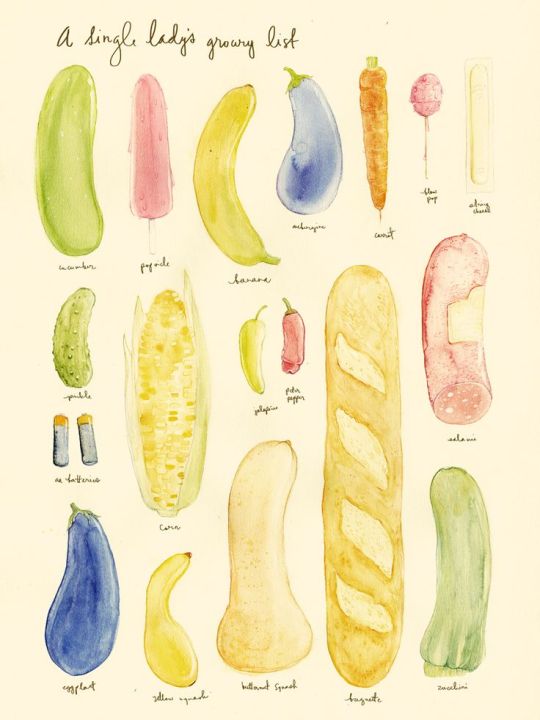
This reminded me of this phallic illustration by Monica Ramos, “A Single Lady’s Grocery List”:

Sunday, March 29, 2015


Documentation: Weeks 3-4

More watercolour drawings to accompany these.

I’ll happily accept that cats are a threat to native NZ wildlife, a pest like any other. I don’t like cats at all. In saying that, I’m a dog lover so it really saddened me to read that ‘The Whangarei Kiwi Sanctuary Study from 2000-2005 showed dogs were responsible for 42 % of kiwi deaths including 69 % of adult kiwi deaths.’ (Department of Conservation website: New Zealand animal pests and threats)

It seems there will be (at least) one more painting in this series.

Saturday, March 14, 2015


Watercolour drawings from week 2. Supposedly our national animal is the kiwi, we even call ourselves kiwis, even though they’re flightless, timid, and so incredibly rare nowadays that most of us will probably never see them in the wild. Meanwhile rabbits and possums and other pests are so common, should we consider them our national animals? Since there are so many more of them in NZ does that make them more kiwi than the kiwi? How about cows and sheep?

And while we think it’s ours, the kiwifruit used to be called the ‘chinese gooseberry’ and was actually brought over from China in the early 1900′s.

  • Thinking about introduced species / pests, about colonisation, immigration, national identity, analogies.

Also recently stumbled on Endre Penovac’s cat paintings and was inspired by his clever technique. The use of watercolour ‘bleeding’ to paint fur is really effective.