
An a4 watercolour sketch based on these images. I'm fascinated by the whole Seralini controversy and am working on some more images with these rats.
Three blind mice.




Documentation: weeks 5-6
The transparent sheets used to produce the previous painting - including scraps from the screen printing room, glad wrap bags from my lunchbox… - aligned and layered on the wall.


Documentation, weeks 5-6:
A test, trying to combine painting with screen printing. I colour-blocked the original photo [which can be seen here] by tracing over specific colour areas on a plastic sheet, which were then projected one at a time onto the canvas with an OHP projector, and I would directly paint over the shadows.
This colour-block layering resembles the process of screen printing - the slight differences in the position of the easel, transparency, and projector, resulted in some mis-registration. I’m happy with the outcome but I’d like to try it again with more transparent paint so the layering process is more evident, perhaps with watercolours.
This is an image of the braided river in the Canterbury Plains. Since the Tuakana trip in 2014 I’ve been thinking a lot about Fonterra’s policy of only buying milk from dairy farms where the cows are fenced off away from the river ways, a move which is imperative to the health of the rivers and the species that live in them, but which is ignored by many farmers. And no such guidelines are enforced with livestock cattle. Hence the problem of polluted rivers…

Documentation: weeks 5-6
Final painting/sketch in this series: rabbit & possum, stoat & rat & cat.
‘The Whangarei Kiwi Sanctuary Study from 2000-2005 showed dogs were responsible for 42 % of kiwi deaths including 69 % of adult kiwi deaths.’
Department of Conservation website: New Zealand animal pests and threats


GERMANY - On a recent visit to the University of Leipzig to review the latest research there, the agriculture minister has called for a practical method to determine the sex of chicken embryos in order to bring to an end the culling of male layer chicks by the end of 2016. Mr Schmidt said that, by the end of 2016, there should be prototypes of a device that determines the sex of chicken embryos at just three days of incubation and then sorts the eggs automatically by gender.
He added that, when such a device is available on the market, there will be no need for the nation’s hatcheries to kill male chicks, a practice that will soon belong in the past.
In the meantime…


Documentation: weeks 3-4
The first painting is like the first pancake: a guaranteed failure.
Based on this reference picture.
A total amateur with oil paints, I made the mistake of starting with the darker colours, which made this painting super mucky from the get-go, so I tried to just roll with it and muck it up even more. Perhaps there’s something conceptual in that struggle: trying + failing to clean up ‘dirty’ river ways.
I found that the turquoise form in the bottom right of the reference picture looked like a face. Perhaps I exaggerated the similarity a bit. Thinking about the land as body + body as land; Gaia - the world as a single organism; river gods and goddesses, i.e. Tangaroa.

Documentation: Weeks 3-4
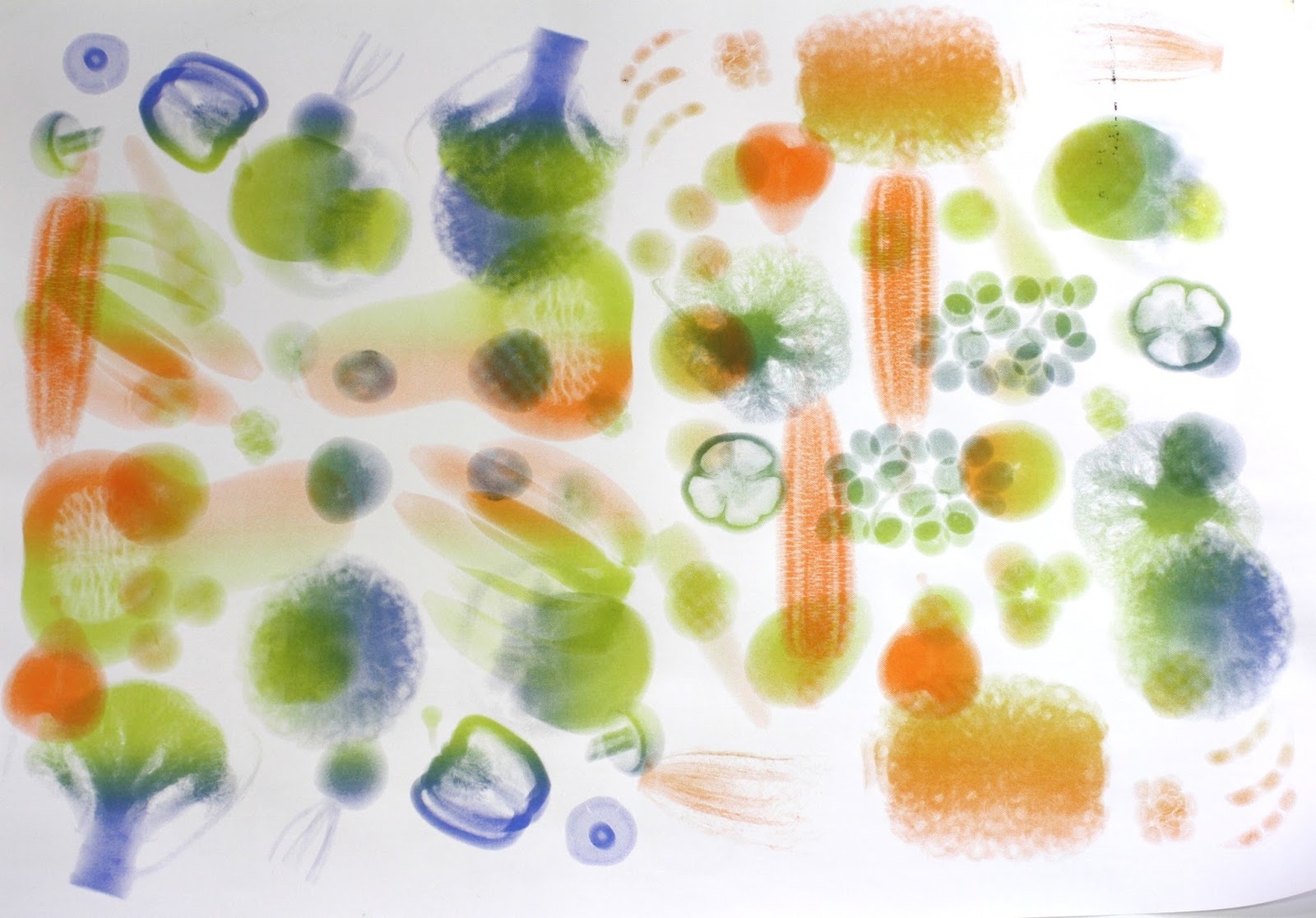
Pick me. Watercolours on paper, A2.
Thinking about organics, pesticides+insecticides, food miles. But mostly about consumer choices. I’ve never actually had any bad quality organic fruit + veg, and it’s not really that much more expensive, so this is just a caricature of our assumptions regarding the quality+price of organic + local produce. The bottom line is that it’s tempting to go for the cheapest option, especially when it’s bigger and prettier.
BUT.
“The average conventionally grown apple has more pesticide residue on it than any other fruit or vegetable. According to the Environmental Working Group‘s analysis of USDA data, pesticides showed up on 98 percent of the more than 700 apple samples tested (yes, they were washed).” (source: Forbes)
Also thinking about Billy Apple since his art is everywhere in Auckland right now. And the apple as a symbol: apple/mac products, Snow White, Eve and the snake and the garden of Eden.


Documentation: Weeks 3-4
“Garden Fresh”
Copper etching, roughly A4 size
When I was younger I was a really really picky eater - the kid who never ate any vegetables, ever.
Eventually I started eating some veggies, but I was incredibly wary of them for most of my teenage years, and if I found a bug in my salad, it was the end of the world, it was totally gross and disgusting and there was no way I going to eat another bite of green stuff, probably for another week at least.
How times have changed. Now I eat as many veggies as I can each day, and if I find a bug on my salad, I just pick it off and keep eating. And when this happens it actually makes me really happy. I take it as a good sign, because:
a: it’s nutritious (the bugs obviously want to eat it and I trust their judgement)
b: it’s super fresh (especially if the bug is still alive - great sign)
c: it means there were no nasty pesticides/insecticides on the plants I’m eating.
Most of the bugs in this etching were drawn using “An illustrated guide to some New Zealand insect families” (Elizabeth A Grant) for reference.
EDIT: This is totally about STDs as well. How shunga are those frilly lettuces?

Documentation: Weeks 3-4
My first attempt at an aquatint etching (using powdered resin to create tonal gradation & a grainy watercolour texture)
A third year student’s comment: “Come on… Surely coffee isn’t that toxic!”
I laughed. That’s not what I was trying to say, but I love hearing surprising new readings of my work.
My thought process for this little drawing was that each time we buy a takeaway cup of coffee, the milk comes from an industry that is responsible for most of our carbon emissions (“50% of New Zealand’s greenhouse gas emissions are attributable tomethane and nitrous oxide, predominantly from agriculture” - A dairy farm is not greenhouse gas neutral (carboNZero media release) PDF) and dairy giant Fonterra is powered mostly by coal (55% - Fonterra Energy website) which “creates more emissions per unit of energy produced when compared with oil or gas” (this article)
Not only that but takeaway packaging is another huge problem in terms of waste and emissions: “According to a study conducted by Starbucks and the Alliance for the Environmental Innovation (April 2000), each paper cup manufactured is responsible for 0.24 lbs of CO2 emissions.” (That’s 108 grams. If you have a coffee five times a week, that’s 28 KILOGRAMS of carbon emissions in a year. And that doesn’t include the plastic lid. Also, if the research was funded by Starbucks I feel that a lot of the stats might well have been rounded down in other ways, too.)
So whether coffee is toxic is debatable, but our takeaway coffee habit is just another way we individual consumers mindlessly contribute our small part - and in some cases on a daily basis - towards our country’s embarrassingly high carbon emissions.
Let the record show that I never never use takeaway containers. I also never eat or drink while driving or walking. It’s something I picked up while living in Japan, where it’s culturally considered rude to eat while in motion: if it’s time to eat or drink, you find somewhere to sit down. Simple as that. So, if I don’t have time to sit in the cafe and drink my coffee from a proper cup, I obviously won’t have time to enjoy it properly and therefore won’t bother buying one. Not only are they an environmental disaster, I think that the need to consume on-the-go food and beverages is an indication of what is fundamentally a lifestyle problem, and we all need to slow down and consume with more mindfulness.


Documentation: Weeks 3-4
More watercolour drawings to accompany these.
I’ll happily accept that cats are a threat to native NZ wildlife, a pest like any other. I don’t like cats at all. In saying that, I’m a dog lover so it really saddened me to read that ‘The Whangarei Kiwi Sanctuary Study from 2000-2005 showed dogs were responsible for 42 % of kiwi deaths including 69 % of adult kiwi deaths.’ (Department of Conservation website: New Zealand animal pests and threats)
It seems there will be (at least) one more painting in this series.


Images from the ‘Paint before you Plant’ workshop (described here in Anita Duller and Hannah Stippl’s website)
It was wonderful to take part in this afternoon of liberating collaborative painting. The patterned rollers we got to use were brilliant.

Watercolour drawings from week 2. Supposedly our national animal is the kiwi, we even call ourselves kiwis, even though they’re flightless, timid, and so incredibly rare nowadays that most of us will probably never see them in the wild. Meanwhile rabbits and possums and other pests are so common, should we consider them our national animals? Since there are so many more of them in NZ does that make them more kiwi than the kiwi? How about cows and sheep?
And while we think it’s ours, the kiwifruit used to be called the ‘chinese gooseberry’ and was actually brought over from China in the early 1900′s.
Also recently stumbled on Endre Penovac’s cat paintings and was inspired by his clever technique. The use of watercolour ‘bleeding’ to paint fur is really effective.


An etching of lucerne, the plant discussed in the Listener article ‘Going with the Flow’, with drawings.
Top: a sheep, since the article was about the use of lucerne on sheep farms. Pencil and watercolour.
Bottom: a leg, drawn in pencil. Thinking about the aesthetic link between anatomical and botanical illustration. I’ve recently found out I have varicose veins on my legs so I guess this is autobiographical, like the stones that appear in Michael Kempson’s prints after he was diagnosed with kidney stones and, as a result, had to give up coca cola.


