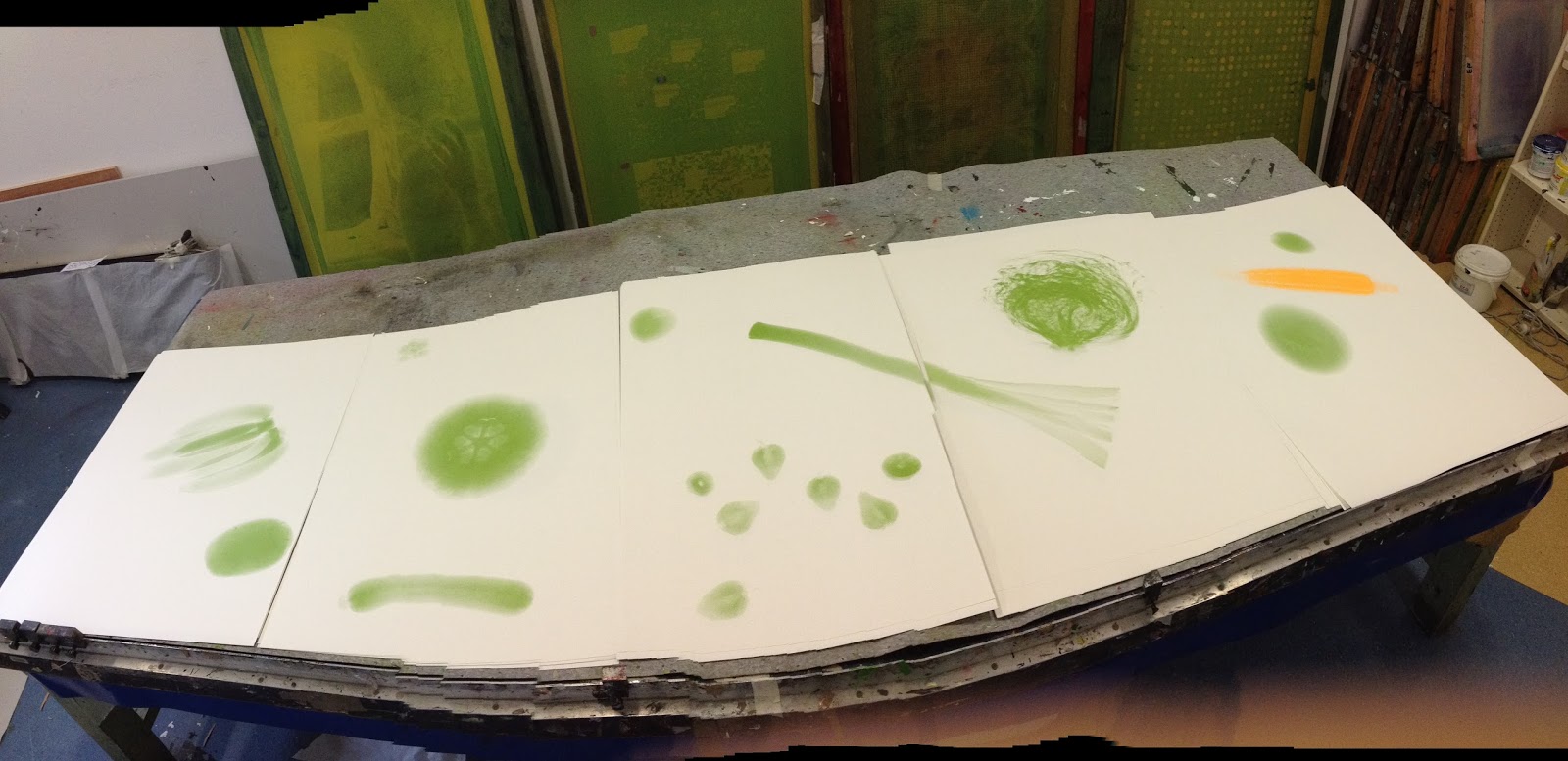
My method was to print the images with no prior planning/designing of the final layout. This led to some troubles by the time it came to do 4th layer, but for the most part this was a liberating approach. There was some deliberation, yes, but I had no idea how the final outcome would look - and I didn't do any initial registration prints onto plastic, either, so each initial print was a surprise.
I did 4 editions of each page (4x5=20 pages total) but with 12+ individual prints on each, I only managed to get one suite of clean final works. So the result is truly an 'original print.'
Above: beginning the second layer
Before cleaning the stencils, I decided to print them on fabric, too.
After the second layer...
And after the third layer.
This is where it became tricky to decide where the next and final layer - blue/winter produce - would be positioned, so I did some cut-outs of tissue paper to play around with the different possibilities.
The result
Finally, since I had four unique soy bean images and four colours to work with, I printed one of each colour - so that, like the conveyor work, it is still a statement about seasonality / globalisation / genetic modification / food deserts / crop diversity (or lack thereof) / processed food, as well as being overtly about biosecurity and processes such as irradiation.
Ellen explained to me how to size paper - now I can paint on my handmade paper without it disintegrating, yay!
Thinking about text art. Dirt and honey | dirty and hungry | diet and money
Also thinking about colour overlapping, the 'screen printing aesthetic' of mis-registration and CYMK colour, and again the idea of printmaking using paint...?
Colour tests for a larger piece. 'Waterre' is a mix of my languages. Wa, Japanese for balance/harmony/unity, or Maori for time/season. Water, english. Terre, french for Earth or dirt.
Whole foods | Wholesome | Some foods?
Sunday, April 12, 2015
Some kind soul left this DVD on my desk last week.
Grandin, who has autism, “is Professor of Animal Science at Colorado State University, and is one of the world’s leaders in the design of livestock handling facilities. She has designed livestock facilities throughout the United States and in Canada, Europe, Mexico, Australia, New Zealand and other countries. In North America, almost half of all cattle processing facilities include a center track restrainer system that she designed for meat plants. Her curved chute (race) systems are used worldwide and her writings on the flight zone and other principles of grazing animal behavior have helped many producers to reduce stress during handling.” - Grandin Livestock Handling Systems
Quotes from the film:
Of course they’re gonna get slaughtered. You think we’d have cattle if people didn’t eat ‘em everyday? They’d just be funny-lookin’ animals in zoos. But we raise them for us. That means we owe them some respect. Nature is cruel, but we don’t have to be. I would'nt want to have my guts ripped out by a lion, I’d much rather die in a slaughterhouse if it was done right.
They’ll be very calm. Nature is cruel but we don’t have to be; we owe them some respect. I touched the first cow that was being stunned. In a few seconds it was going to be just another piece of beef, but in that moment it was still an individual. It was calm… and then it was gone. I became aware of how precious life was. I thought about death and I felt close to God. I don’t want my thoughts to die with me. I want to have done something.
You know, the slaughter plants, I’ve worked with them in the '80s; they were absolutely awful. I developed a really simple scoring system for slaughter plants where you just measure outcomes: How many cattle fell down? How many cattle got poked with the prodder? How many cattle are mooing their heads off? And it’s very, very simple. You directly observe a few simple things. It’s worked really well. I get satisfaction out of seeing stuff that makes real change in the real world. We need a lot more of that, and a lot less abstract stuff.
So how do nuts stack up to meats? When comparing the global average water footprints, nuts overall have a far lower water footprint when looking at per ton and calorie rates, especially when compared with beef, according to a report on the water footprint of animal products which you can download in full here. Replacing all meat by an equivalent amount of crop products such as pulses and nuts will result in a 30% reduction of the food-related water footprint of the average American citizen,“ water experts and authors of the report, Mesfin Mekonnen and Arjen Hoekstra say.
An interesting (however unprofessional) website full of photos and factoids about the darker side of NZ’s “clean and green” image. There are some really striking photos in the slideshows, especially of cow herds under the heading ‘dirty dairying’.
Sunday, March 29, 2015
Documentation: Weeks 3-4
My first attempt at an aquatint etching (using powdered resin to create tonal gradation & a grainy watercolour texture)
A third year student’s comment: “Come on… Surely coffee isn’t that toxic!”
I laughed. That’s not what I was trying to say, but I love hearing surprising new readings of my work.
My thought process for this little drawing was that each time we buy a takeaway cup of coffee, the milk comes from an industry that is responsible for most of our carbon emissions (“50% of New Zealand’s greenhouse gas emissions are attributable tomethane and nitrous oxide, predominantly from agriculture” - A dairy farm is not greenhouse gas neutral (carboNZero media release) PDF) and dairy giant Fonterra is powered mostly by coal (55% - Fonterra Energy website) which “creates more emissions per unit of energy produced when compared with oil or gas” (this article)
Not only that but takeaway packaging is another huge problem in terms of waste and emissions: “According to a study conducted by Starbucks and the Alliance for the Environmental Innovation (April 2000), each paper cup manufactured is responsible for 0.24 lbs of CO2 emissions.” (That’s 108 grams. If you have a coffee five times a week, that’s 28 KILOGRAMS of carbon emissions in a year. And that doesn’t include the plastic lid. Also, if the research was funded by Starbucks I feel that a lot of the stats might well have been rounded down in other ways, too.)
So whether coffee is toxic is debatable, but our takeaway coffee habit is just another way we individual consumers mindlessly contribute our small part - and in some cases on a daily basis - towards our country’s embarrassingly high carbon emissions.
Let the record show that I never never use takeaway containers. I also never eat or drink while driving or walking. It’s something I picked up while living in Japan, where it’s culturally considered rude to eat while in motion: if it’s time to eat or drink, you find somewhere to sit down. Simple as that. So, if I don’t have time to sit in the cafe and drink my coffee from a proper cup, I obviously won’t have time to enjoy it properly and therefore won’t bother buying one. Not only are they an environmental disaster, I think that the need to consume on-the-go food and beverages is an indication of what is fundamentally a lifestyle problem, and we all need to slow down and consume with more mindfulness.
Very provocative works that broach the big topics: religion / science / violence / ethics / animal welfare / agriculture…
This got me thinking some more about connections between religion and agriculture. An interesting article by organic farmer Robb Waldridge:
“It seems as though food politics is on the verge of becoming religion; if we haven’t already, we’re about to split into sects and factions, driven apart by ideological dogmas that have nothing to do with reality.”
“The result? Each group ends up “preaching to the converted”. Or worse yet, preaching to the choir. A priest who preaches to the choir turns her back on the congregation, the populace, to speak only to those who will sing hymns of praise.”
“In my opinion [a more complete, nuanced understanding] should be a chief goal of all who communicate on food and agricultural issues. Rather than cloistering with the like-minded to codify ideas and thoughts into unchanging dogma so that we can worship it and fight wars over it centuries later, I’d prefer to collaborate with all stakeholders and find opportunities to move forward, to seek understanding, to find solutions to the challenges facing us. Surely, we should be able to expect the same from the leaders of the “food movement.””
Also found this text from 2005: Religion and Agriculture:Sustainability in Christianity andBuddhism, Lindsay Falvey (PDF)
Food production andits science are natural actions that fit into the natural flow, butintentions to gain unnecessary advantage at the expense of
others upsets that natural flow. Ignorance of the natural flow
in no way mitigates the suffering caused by ‘good but ignorant
intentions’. These teachings are clear in Buddhism and just as
in other religions, they are supported by allegories.
The Jataka is a collection of allegories adapted to
Buddhism from pre-existing tales that have separately come
into Western culture as Aesop’s Fables. They portray the
Buddha’s previous lives as moral principles. One example will
suffice. Once upon a time, a goat was led to a temple and was about to be sacrificed by the presiding Brahman. Suddenly the goat let out a laugh and then uttered a moaning cry. The Brahman, startled by this odd behaviour, asked the goat what was happening. The goat responded as follows: ‘Sir, I have just remembered the history of what has led to this event. The reason I have laughed is that I realized that this is the last of 500 births that I have suffered as a goat; in my next life I will return again as a human. The reason I have cried is out of compassion for you. You see, 500 births ago I was a Brahman, leading a goat to the sacrifice. After killing the goat, I was condemned to 500 births as a goat. If you kill me, you will suffer the same fate’. The Brahman, visibly shaken, immediately released the goat, who trotted away. A few minutes later, lightning struck the goat and he was freed to become a human again. The Brahman likewise was spared, due to the goat’s compassionate intervention.Set in a time of animal sacrifice, the above tale made
teachings of non-violence more intelligible to the masses. We can argue that it is clearly not intended to be understood
literally in a modern abattoir – but on the other hand, we do
well to ask why in modern societies great effort is invested in separating killing from meat consumption. At the very least it
places an undue burden for meat animals’ welfare on the very few who do the dirty work. An intention to minimize the harm
we do in everyday life would highlight this illogicality, which
explains the association of vegetarianism with spiritual
awareness. But vegetarianism is no more an ethic of Buddhism
than it is of Christianity – it appears in the scriptures of both,
as do passages that appear to condone meat consumption.
And in both scriptures, it is the intention and situation of the
act that is the key. Inflexibly following a personal ‘law’ is
anathema to spiritual awareness. In societal terms, however,
there is a benefit from general laws, which in large parts of the
world extend so far beyond Western sensitivities that they are
often dismissed as irrelevant, such as Indian attitudes to cattle
-page 195-196
On a side note, I want to look more into this idea of the cow as a sacred figure in Hinduism, after reading elsewhere that ‘cows figure frequently (in the Rig Veda) as symbols of wealth and in comparison with river goddesses’ - a wonderful connection between ancient religious script and NZ’s dairy industry and subsequent river pollution.
!!!!!
I’m also really interested in other aspects Indian culture, especially Ayurvedic concepts regarding the connectedness of diet + lifestyle + physical/mental health.
My local butcher store is right next to a vet, and I find that really unfortunate. Always have. I’ve gone past these neighbouring shops almost every day of my life.
This arrangement is kind of Sweeney Todd. A place where people get their pets put down, right next door to a store selling animal flesh for consumption? I’d ask my mum, ‘how can we be sure we sure we’re buying pork and not a dog that was ‘put down’ next door?’
Even if that were the case, what’s the difference? We find it weird or gross that some cultures eat dogs or cats, but why? Why this distinction? Sometimes referred to as “speciesism.”
A dog owner can take her precious poodle to get pampered and while she’s there, buy some meat from next door. A relatively normal situation. Convenient, even. But for me that sums up the double standards we have towards animals. On the one hand we have a picture of cuddly cute dogs and cats, a place for getting your pets checked up, getting medicine and their nails cut and thousand-dollar operations. Essentially, a shop where animals are treated like humans. And on the other hand, we have a display of cuts of flesh in the store window. A polar opposite animal industry, where animals are raised for slaughter, treated horrendously, killed brutally, out of sight and out of mind. Freedom farms! Juicy pork, full of flavour. Pigs are more intelligent than dogs…
Found here
38 minutes in, she uses a phrase that really interests me ‘the romanticisation of agriculture’
I’m very wary of dairy advertising. At $13.7 billion worth of exports the dairy industry is hailed as the heart of our country’s economy, so I don’t think they want anyone to know about the dark side of their ‘white gold’.
What dark side?
How about the fact that, despite everything we’re told about calcium, ‘the countries with the lowest milk consumption have the lowest risk of osteoporosis and fractures’? How about all the studies that have disproved the supposed benefits of cow’s milk / proved that cow’s milk actually leads to increased bone fracture and osteoporosis? The connection between milk consumption and type 1 diabetes? Acne? Intestinal bleeding in infants? ‘There is absolutely no biological requirement for milk.’ (Huffington Post: Got Proof?)
However, of course, the information promoted by dairy companies is entirely in their favour. Milk is great source of protein! (Yeah, because baby cows need to grow a lot more than baby humans. Obesity epidemic? No connection!) According to Anchor’s website: High quality dairy protein containing all 20 amino acids, means dairy products can be a one-stop shop for protein!
The dairy industry doesn’t want us to know about the connection between high consumption of animal proteins and cancer (four times more likely - the same risk as smoking!) : a connection that “almost vanished when the researchers considered participants whose protein mainly came from plants, such as beans.” (Cell Metabolism journal, March 4.)
Which makes me think about other studies which have proved that industry-funded research is ‘4-8 times more favourable to the financial interests of the sponsors.’ (see ‘Relationship between funding source and conclusion among nutrition-related scientific articles.’)
This stuff doesn’t get a lot of attention from NZ’s media. Granted, stuff.co.nz posted the article, the NZ herald posted this one where Professor Plant talks about drawing the connection between a traditional asian diet and low rates of breast cancer in China (“Chinese women had historically very low rates of breast cancer: one epidemiological study from the 70s showed the disease affected one in 100,000 Chinese women, compared with one in 12 in the West” … “at that time they did not have a dairy industry. It was a revelation.”) Which reminds me of another book, The China Study (full text). Milk can double risk of early death. High milk intake and increased mortality.
But the casein in dairy milk, ‘a slow-release protein that can sustain you for longer’ (Anchor’s website) contains casomorphins which act like opiates in your bloodstream. Dairy is actually addictive.
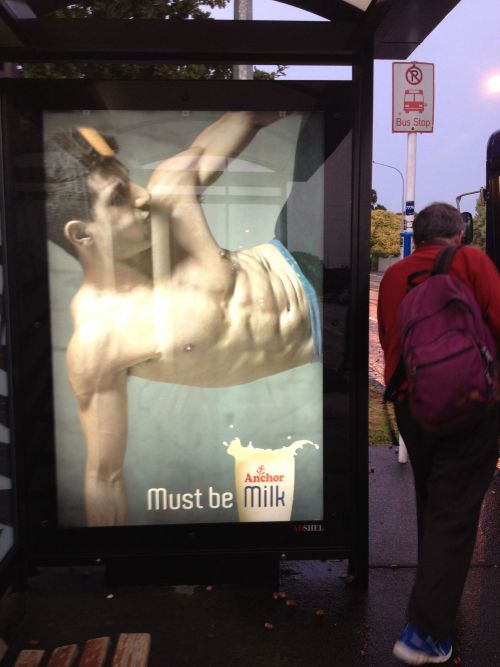
But on the whole, New Zealanders are consuming less milk, so there’s a lot of advertising around right now to try and reverse that trend. Fonterra’s “milk for schools” campaign was a case in point. And bus stops all over Auckland are currently plastered with the rippling abs of a muscular male dancer with the caption, ‘Must be milk’ (Right! We need animal protein! Protein is good! Milk will make you strong and attractive!)
Is it OK for children to drink something biologically tailored for newborns of another species? Do we think about what we’re really consuming, how it’s from the lactating teat of a mother? Is that really masculine, like the posters in the bus stop would have you believe? Should we be forking out more and more money for a product that scientists are likening with tobacco?
Dairy milk is made for calves, not for kids. Not for adults either. Not for humans in general.
These are the things I’m thinking about when I do stupid drawings like these.
Thursday, March 5, 2015
Last night I went along to this film screening of ‘Hot Air’ (click here for the youtube trailer.) There were countless moments in this documentary when I had to hold my head in my hands, or found myself swearing out loud. Especially when one MP being interviewed said something along the lines of: 'Coal is not a renewable resource. It’s a bit like having money in the bank if you’re dying. So the best thing to do is to mine it, and use it, to benefit the economy while you can. In that way, you could almost say that coal is a renewable resource!’
The documentary follows the tactics employed by the government over the past few decades to deny, spread doubt, and delay any action whatsoever, regarding climate change. This in favour of expanding our coal industry - only marginally cheaper than other energy sources yet entirely unsustainable and environmentally destructive. The New Zealand government’s total inaction regarding climate change - and the 25% increase in our carbon emissions in the past couple of decades, the opening of more coal mines, nationwide deforestation for new dairy farms, and withdrawal from the Kyoto protocol - is absolutely shameful.
Jeanette Fitzsimmon’s talk afterwards was no doubt the highlight of the event. While the film finishes on an unresolved note, leaving the audience shocked and feeling as if the situation is hopeless, her common sense optimism restored my sense that change is possible. But as she puts it, change doesn’t come from the government. That is, parliament cannot - or will not - initiate change, as the documentary proved all too well. As she puts it, the government will be the very last to respond to climate change and they will only do so once the general public have made it loud and clear that that is what we want.
Basically what I got out of this event was the sense that it is my duty not only to make positive change on a personal level, but also to do as much as I can to contribute to the noise.
An interesting concept that Jeanette mentioned was that in traditional Maori culture, the standard of forward thinking was to ask: will this last for the next 7 generations? Whereas our government only thinks three years ahead…
Most of us would never dream of being cruel to an animal. The thought of inflicting pain and suffering on an innocent and vulnerable animal is not something one aspires to, and certainly - New Zealand Herald
“Factory farmed animals are exempt from the Animal Welfare Act, making it legal to subject pigs and chickens to inarguably cruel conditions and depriving them of their basic needs.”