But this technique for picturing food is not a recent revelation born out of Tumblr or Instagram. In 1960, Swiss artist Daniel Spoerri constructed his first snare pictures: assemblages of objects like plates, coffee cups and ashtrays glued on to tables from restaurants and domestic spaces, recreating the exact arrangement of how the items were found. Spoerri, who identifies as a “paster of found situations,” sources these assemblages from specific and personal instances. For example, when his girlfriend Kichka left her breakfast dishes and dregs in the kitchen one morning, Spoerri attached the readymade composition of leftover eggshells, coffee pots and cigarette butts to a wood panel and titled it Kichka’s Breakfast I.
In this process, Spoerri turns meal into memory. When Spoerri installs his work, he attaches it to the wall, facing outward. These foreshortened, wall-bound objects read as rectangles, inviting the audience to approach the pieces as two-dimensional surfaces rather than as sculptures. Spoerri’s snare pictures challenged the conventions of traditional still-lifes, notable in oeuvres ranging from Jean-Baptiste-Siméon Chardin’s to Wayne Thiebaud’s, long before the advent of the Internet.
...
These one-trick ponies are the dispensable images that inundate our contemporary visual culture and cloud our understanding of the nuanced difference between an aesthetically pleasing picture and a compelling photograph.
...
If we, as photographers or viewers, assume the point-of-view of God (or the Cloud, whichever operates at the center of your personal belief system), we expose our own buried desire to have complete control over the food we consume.
....we are programmed to be enchanted by an aerial viewpoint that perceptually flatters our innermost ambition to be omnipotent.
Peter Singer, the groundbreaking ethicist whom The New Yorker calls the most influential philosopher alive teams up again with Jim Mason, his coauthor on the acclaimed Animal Factories, to set their critical sights on the food we buy and eat: where it comes from, how it is produced, and whether it was raised humanely. The Ethics of What We Eat explores the impact our food choices have on humans, animals, and the environment. Recognizing that not all of us will become vegetarians, Singer and Mason offer ways to make healthful, humane food choices. As they point out: You can be ethical without being fanatical.
The continual readjustments in the life of a city reflecting the total social relations of its inhabitants, lead to the concept of a city as a living organism. That such a concept is popularly held is shown by the common phrases, the “heart” of the city, to represent the business centre, the “arteries” of traffic to represent the streets, the ‘lungs" of the city to represent the parks, and to carry the simile further the railroad depots and wharves may be called the mouths through which the city is fed, the telephone and telegraph lines its nervous system, while man in his residence has been likened by Spencer to a particle of protoplasm surrounding itself with a cell.
Judy and I have talked a lot about the significance of analogies... Marshall McLuhan, the concept of Gaia, etc
Bayer, BASF and Syngenta are suing the European Commission to overturn a ban on the pesticides that are killing millions of bees around the world. The dangerous chemicals Bayer and Co. make are neonicotinoids, or neonics. Neonics are soaked into seeds, spreading through the plant and killing insects stopping by for a snack. These pesticides can easily be replaced by other chemicals which don’t have such a devastating effect on the food chain. But companies like Bayer, BASF and Syngenta make a fortune from selling neonics – so they’ll do everything they can to protect their profits. The EU banned these bee-killers in May 2013, after a massive public campaign and a clear scientific finding from the European Food Safety Authority that neonics pose huge risks to bee populations.
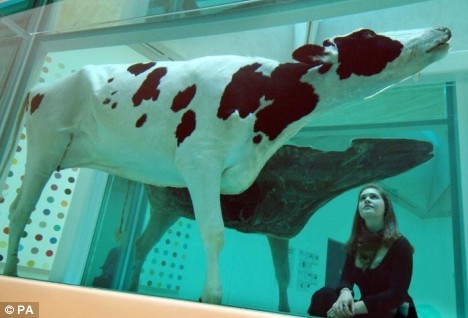
Very provocative works that broach the big topics: religion / science / violence / ethics / animal welfare / agriculture…
This got me thinking some more about connections between religion and agriculture. An interesting article by organic farmer Robb Waldridge:
“It seems as though food politics is on the verge of becoming religion; if we haven’t already, we’re about to split into sects and factions, driven apart by ideological dogmas that have nothing to do with reality.”
“The result? Each group ends up “preaching to the converted”. Or worse yet, preaching to the choir. A priest who preaches to the choir turns her back on the congregation, the populace, to speak only to those who will sing hymns of praise.”
“In my opinion [a more complete, nuanced understanding] should be a chief goal of all who communicate on food and agricultural issues. Rather than cloistering with the like-minded to codify ideas and thoughts into unchanging dogma so that we can worship it and fight wars over it centuries later, I’d prefer to collaborate with all stakeholders and find opportunities to move forward, to seek understanding, to find solutions to the challenges facing us. Surely, we should be able to expect the same from the leaders of the “food movement.””
Also found this text from 2005: Religion and Agriculture:Sustainability in Christianity andBuddhism, Lindsay Falvey (PDF)
Food production andits science are natural actions that fit into the natural flow, butintentions to gain unnecessary advantage at the expense of
others upsets that natural flow. Ignorance of the natural flow
in no way mitigates the suffering caused by ‘good but ignorant
intentions’. These teachings are clear in Buddhism and just as
in other religions, they are supported by allegories.
The Jataka is a collection of allegories adapted to
Buddhism from pre-existing tales that have separately come
into Western culture as Aesop’s Fables. They portray the
Buddha’s previous lives as moral principles. One example will
suffice. Once upon a time, a goat was led to a temple and was about to be sacrificed by the presiding Brahman. Suddenly the goat let out a laugh and then uttered a moaning cry. The Brahman, startled by this odd behaviour, asked the goat what was happening. The goat responded as follows: ‘Sir, I have just remembered the history of what has led to this event. The reason I have laughed is that I realized that this is the last of 500 births that I have suffered as a goat; in my next life I will return again as a human. The reason I have cried is out of compassion for you. You see, 500 births ago I was a Brahman, leading a goat to the sacrifice. After killing the goat, I was condemned to 500 births as a goat. If you kill me, you will suffer the same fate’. The Brahman, visibly shaken, immediately released the goat, who trotted away. A few minutes later, lightning struck the goat and he was freed to become a human again. The Brahman likewise was spared, due to the goat’s compassionate intervention.Set in a time of animal sacrifice, the above tale made
teachings of non-violence more intelligible to the masses. We can argue that it is clearly not intended to be understood
literally in a modern abattoir – but on the other hand, we do
well to ask why in modern societies great effort is invested in separating killing from meat consumption. At the very least it
places an undue burden for meat animals’ welfare on the very few who do the dirty work. An intention to minimize the harm
we do in everyday life would highlight this illogicality, which
explains the association of vegetarianism with spiritual
awareness. But vegetarianism is no more an ethic of Buddhism
than it is of Christianity – it appears in the scriptures of both,
as do passages that appear to condone meat consumption.
And in both scriptures, it is the intention and situation of the
act that is the key. Inflexibly following a personal ‘law’ is
anathema to spiritual awareness. In societal terms, however,
there is a benefit from general laws, which in large parts of the
world extend so far beyond Western sensitivities that they are
often dismissed as irrelevant, such as Indian attitudes to cattle
-page 195-196
On a side note, I want to look more into this idea of the cow as a sacred figure in Hinduism, after reading elsewhere that ‘cows figure frequently (in the Rig Veda) as symbols of wealth and in comparison with river goddesses’ - a wonderful connection between ancient religious script and NZ’s dairy industry and subsequent river pollution.
!!!!!
I’m also really interested in other aspects Indian culture, especially Ayurvedic concepts regarding the connectedness of diet + lifestyle + physical/mental health.
A while ago I was doodling fruits and vegetables, writing idioms for captions where one word was replaced by a fruit/vegetable (e.g. absence makes the heart grow figs, curiosity killed the carrot, home is where the artichoke is, easier said than durian….)
A quick Google search and I realised this wasn’t as original as I thought it was. Still very entertaining. I love puns and word play in illustration.
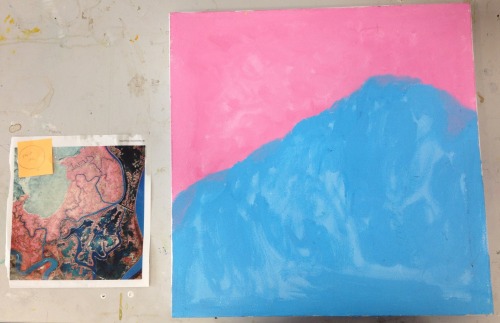
Image from ‘New Scientist’ magazine last year. I love satellite images of riverways.
This image has been begging me to paint it, and I found this canvas during the local inorganic collection last week. Looks like someone’s already done the undercoat for me. Meant to be?
Thursday, March 12, 2015
Just found this fantastic page of satellite images of NZ. I’m fascinated by the use of false colours in maps and in microscopic/astronomic photography.