Showing posts with label bees. Show all posts

Friday, August 21, 2015

Documentation: Corn on acrylic

These were test prints on scrap acrylic. They caught the supervisor's eye in my cross-group crit a couple of weeks ago, and were passed around, with some surprisingly positive feedback.


In terms of colour, I think the print above is the most successful: opaque white on translucent black. By comparison the yellow ink in the other two gets lost, but there is enough contrast in the one above to clearly see the image. And there is something noticeably medical about the x-ray on dark tinted acrylic. 


The above is printed on clear acrylic. The sheet was left over from when I did laser-cut honeycomb patterns and prints at the start of the year. At the time this attempt was a hot mess. We quickly realised with this one that it was the wrong type of plastic, hence the melting and burned effect and incompletion. I held onto the remnants, though, in case it might come in handy later in the year - and it did!
I'd been wanting to make a work which draws a comparison between a honeycomb pattern (yellow, geometric, speaks to contemporary discussion about bees - decline in bee population, possible causes eg. pesticides and destruction of natural habitats) and a corn cob (also yellow, geometric, small kernels - the exact same size as a beehive hexagon, speaks to consumerism, modern farming, GMOs, pesticides, etc...) - the two patterns are an aesthetic + conceptual match made in heaven.
The smoky texture also speaks to things like smoking beehives to calm the bees; fire - a sense of danger; the fact that it's just a segment of the cob makes it looks like a bite has been taken out of it, a possible analogy for 'consuming' or destroying the land via monocrops...

If I could do it again it would be printed in black, not yellow.

Monday, June 8, 2015

Documentation week 14 - beeswax wrap


 This has got to be the thriftiest thing I have ever made.


I've been keeping the winter blues at bay by lighting candles in the evening, and avoiding paraffin candles in favour of beeswax ones from the farmer's market. Anyway, I had some leftover candle stubs from these.

When I was printing the textiles for these bags, I brought along some scrap fabric to do a test print on. I'm glad I held onto it afterwards.

Leftover beeswax + leftover scrap fabric + leftover test print = ...


A re-usable alternative to plastic wrap. Up-cycled three ways. Coated in beeswax, it seals containers, sticks to itself and to other surfaces, softened by the warmth of your fingers. And it smells amazing.

Wednesday, May 20, 2015

Michael Hight

a.k.a. 'the beehive painter'

Some works from his recent show 'Crossing the Line' 

The 2012 exhibition The Dreams of Children signalled a shift in Michael Hight’s painting practice. The black paintings had a dramatic and nocturnal quality which is extended in Crossing the Line as the new works continue Hight’s fascination with memory, archives, encyclopaedias and the surprising relations between things. Each work is like a theatrical tableau placed upon a shelf against a black backdrop for the viewer to behold. A handful of elements are juxtaposed to produce multiple effects—luminous paintwork, autobiographical threads, historical narratives, psychological judders, allegory, metaphor and so on. In contrast to Hight’s beehive paintings, these works feature landscape on a reduced scale. It is partitioned off and rattles against the things and people placed in the scene. At times, the paintings generate a sense of unease, the macabre, the unfamiliar, a visual puzzle. At other times, the effect is nostalgic, moving, deeply familiar.The exhibition, Crossing the Line, takes its title from the ceremonies ships engaged in when they crossed the Equator in the 1880s. This ceremony is featured in the exhibition’s largest painting of the same title.


Micheal Hight is a self-taught painter who has been exhibiting regularly since the late 1980s. He has a Bachelor of Social Science and undertook extensive travel through North America, Europe and North Africa in the eighties. He is most commonly associated with his realistic depictions of beehives in the New Zealand landscape, particularly in Central Otago and Canterbury.
More recent works have temporarily left behind his identifiable landscapes in favour of surreal dreamscapes within which a personal sense of real childhood innocence is evident. His use of juxtaposition, ambiguous symbols and an overwhelming sense of the dark and mysterious, together create an uncertainty in these works that is as curiously haunting as it is beautiful.

Monday, April 27, 2015

Documentation: Weeks 7-8 Stamps


The linocuts used for this piece, which I this week made into actual stamps.

Sunday, April 26, 2015

Documentation Weeks 7-8

After my research for the printmaking workshop/exhibition, I'm still interested in bees and paper making. A couple of weeks ago I was trying to find some steel honeycomb (which is used in the bottom of the laser cutter, and I've also seen it in the base of food cabinets in cafes...), and after hours of searching online and going to different hardware shops, I found one place in Newmarket that sold it... 
in 3 metre panels, shipped from overseas, at $1200 each.
Not going to happen.
But, in this same shop, a sample of a sort of folded cardboard panel caught my eye. And I thought maybe I'll just MAKE some honeycomb.


I first tried it with yellow pages, but the paper was too thin to be able to see and work with the folds. So I picked up a piece of scrap card to experiment with. The result was this little test:


Admittedly, it annoys me that it's not geometrically spot-on; but hopefully I'll find a better + more accurate technique for folding and gluing.
I was surprised by how much I liked the effect of the bits of writing that are visible in the honeycomb cells. Hope to push this idea...

Above: displayed with an embossed etching of bees in honeycomb

Saturday, March 21, 2015


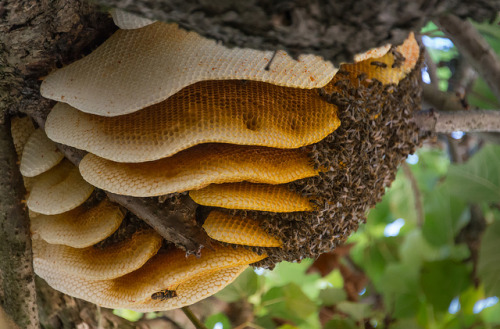
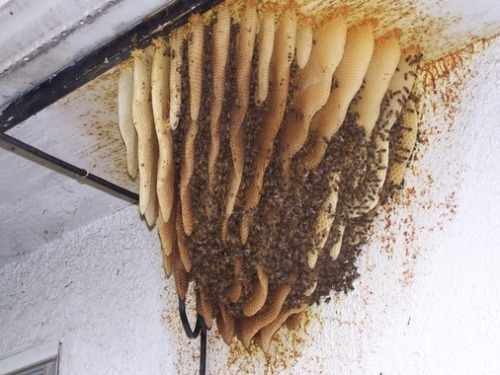
Dwyer Kilcollin’s sculptures make me think of the amazing natural forms of wild beehives:

All I can think is, what a waste of honey!!

Preservation has many meanings, from the physical to the spiritual. At the most basic – and perhaps the most important – level it can denote survival. Hence the idea of protection, inherent in the term. But while the word often implies a kind of stability, or even stasis, preservation also comes about through transformation: wild animal preserves come to exist only by being separated from hunting grounds; fruit preserves are made from hours and hours of boiling, creating a sweet, lasting essence.
Blake Little’s series of photographs presented here combine the old and the new in a bold way. His vivid images startle the viewer. They freeze the human form, preserving it not in proverbial amber, but rather – and unexpectedly – in honey, another natural substance millions of years old. (For honey bees date back some 25-50 million years, preserved in the fossil record of the Eocene–Oligocene boundary.) Just when and where humans first braved the sharp sting of bees to steal their honey we do not know. Cave paintings in Spain depict human honey-gatherers, and from the time of the Egyptian pyramids, about 2575–2150 BC, what scientists now call the “honey-bearing” bee (Apis mellifera) appears to have been domesticated.
As there was no cane sugar in the Old World, honey was highly valued for its sweetness, but for other qualities as well. It can function as a medicine as well as a preservative, for under the right conditions does not spoil. Honey sealed in ancient tombs can remain safe to eat to this day. In Egypt and other early cultures around the world it was offered to the gods both in its semi-liquid state and in the form of honey-cakes. Greek and Roman poets wrote of pouring libations of honey mixed with milk or wine, and it plays a significant role in several ancient myths. It was honey’s viscosity, as well as its color, transparency, and luminosity that compelled Blake to experiment with the material. Innovatively, he applied the substance to the human body, first in drips, then in sheets, creating gleaming, vibrant forms, which, though far from imitative, recall, in different ways those made by Auguste Rodin, Francis Bacon, and Jeff Koons.
Blake saw – and was intrigued by – the juxtaposition of the timeless, pure substance and human flesh, so prone to decay. He was amazed by honey’s transformations when dripped, dribbled, and poured over the human body, and how it can distort and amplify forms, highlight physical perfection, engender repulsion, and suggest both immortality and death. For Blake, gleaming, golden honey has a way of diffusing the personal qualities of his subjects, often making them unrecognizable, democratizing their individual traits into something altogether different and universal. Sometimes terrifying, it can seem to encase his subjects, almost larvae-like in a primordial ooze, as in Ouriel, front, 2012. At other times it is dynamic, its lively motion captured and frozen, in a very different sense, through stop-action imaging, its tendrils – almost electric – spinning forth (Clayton, 2013). Powerfully muscular bodies, like Devion, back 2012, and gracefully balanced poses, such as Tala, standing up, 2013, evoke works of classical art, such as the famous Discus-thrower of the ancient Greek sculptor Myron. Other images recall sober portraits of the Renaissance (Dylan, 2012; Brad, 2012 and Zayden, 2013), or the dainty ballerinas of Degas in Lindsay, 2013.
Whether thick or thin, the substantiality of the honey is ever present, and because the experience of being covered in it is far from natural – indeed, can be suffocating – many of the subjects seem to struggle, while others surrender themselves to it. In this, and in other ways, the images in these pages recall those (made familiar by photographers of a very different era) of the plaster casts of the victims of Vesuvius, whose bodies have disappeared, but whose evocative forms remained in hollows in the ash that buried them during the disaster that destroyed the ancient cities of Pompeii and Herculaneum during the eruption of A.D. 79, which, paradoxically, simultaneously destroyed and preserved them and have become something of a byword for the fleetingness and unpredictability of human life.
Howsoever intense, grueling, and frightening it may be to be covered by cascading sheets of honey, all of Blake’s subjects fortunately remain very much alive – thanks both to the marvellous properties of this age-old material and the evocative power of his evolving art.
Kenneth Lapatin, Associate Curator of Antiquities, J. Paul Getty Museum

This is terrible

Bayer, BASF and Syngenta are suing the European Commission to overturn a ban on the pesticides that are killing millions of bees around the world.
The dangerous chemicals Bayer and Co. make are neonicotinoids, or neonics. Neonics are soaked into seeds, spreading through the plant and killing insects stopping by for a snack. These pesticides can easily be replaced by other chemicals which don’t have such a devastating effect on the food chain. But companies like Bayer, BASF and Syngenta make a fortune from selling neonics – so they’ll do everything they can to protect their profits.
The EU banned these bee-killers in May 2013, after a massive public campaign and a clear scientific finding from the European Food Safety Authority that neonics pose huge risks to bee populations.

Petition here.

Thursday, March 19, 2015


EIPW 2015 exhibition at George Fraser gallery

Bee on the Frame I (Etching: ink on paper, laser-cut perspex, handmade frame polished with beeswax)

Bee on the Frame II (Screenprinting frame, photo-emulsion)


An edition of 12 mini prints - gifts for the visiting printmakers who attended the EIPW in January. These were made with the stamps cut by the laser cutter (from hand-drawn images scanned into Illustrator) and water-based ink.


It was so exciting to get free (free!) reign of the laser cutter during the EIPW in January. Using it to cut and engrave several hand-drawn honeycomb patterns, I was thrilled to realise that the bed of the laser cutter, too, is honeycomb patterned. How perfect; the connection was too good to be true. A mechanical, man-made structure, and the most efficient pattern is found in nature - the least possible perimeter so that bees use less energy+wax. Common sense creatures.

We also worked out, with a lot of trial and error, which settings could burn into lino - a mechanical linocut! - and I made several little laser engraved and cut-out bee stamps. 

Next time I’ll use the other 3D cutter as it has a ‘stamp’ setting, which gives slanted edges to the engraved parts. (Next time I’ll also have to pay for it, unfortunately!)

Wednesday, March 18, 2015


Beehives at my local reserve, Waitaramoa. I love the (inadvertent?) colour schemes of beehive boxes, and how precariously these are stacked!