Showing posts with label photo. Show all posts

Sunday, April 12, 2015


Today I saw ‘Coke Life’ in the supermarket for the first time and it made me so angry. Just because you slap a green label on something that doesn’t necessarily mean it’s any better for you or for the planet.

Then again, the marketing works. I myself am instinctively drawn to green things. Or things which claim to be green, eco-friendly, etc. 

Maybe it’s just about colour associations. Maybe the reason I bought my plastic green iPhone cover was because somehow, on some weird subconscious level, the colour green made me feel like it was a good choice. Green man says go!

So seeing these coke bottles brought this thought process to light as being obviously and absurdly ridiculous. Because I’d still never drink coke in any of its forms, whether original, zero, diet, or ‘life’ - I simply won’t touch anything that processed. But ‘coke life’ is directly targeted at health-conscious people like me. 

I felt targeted, dissected, exposed. They’ve figured out that to pull us green-smoothie-and-yoga suckers in: all we need to see are the words ‘natural’ / ‘reduced sugar’… but most importantly, of course, green packaging with a picture of a plant on it. It’s that simple.

“The devil hath power to assume a pleasing shape…”


I’ve been thinking a lot about labels like these that we get bombarded with, and which appeal to those of us who fancy ourselves as conscious-consumers, i.e. who are willing to fork out an extra few dollars for something if we see it has a ‘green’ label of some sort because it makes us feel better about ourselves. Excuse my cynicism; I still do it. 

But how many of us are really informed about what any of these actually indicate? And how many of these labels actually mean effective change? How many of them are as fake and empty as coca-cola’s new claims?


Some kind soul left this DVD on my desk last week. 

Grandin, who has autism, “is Professor of Animal Science at Colorado State University, and is one of the world’s leaders in the design of livestock handling facilities. She has designed livestock facilities throughout the United States and in Canada, Europe, Mexico, Australia, New Zealand and other countries. In North America, almost half of all cattle processing facilities include a center track restrainer system that she designed for meat plants. Her curved chute (race) systems are used worldwide and her writings on the flight zone and other principles of grazing animal behavior have helped many producers to reduce stress during handling.” - Grandin Livestock Handling Systems

Quotes from the film: 

Of course they’re gonna get slaughtered. You think we’d have cattle if people didn’t eat ‘em everyday? They’d just be funny-lookin’ animals in zoos. But we raise them for us. That means we owe them some respect. Nature is cruel, but we don’t have to be. I would'nt want to have my guts ripped out by a lion, I’d much rather die in a slaughterhouse if it was done right.
They’ll be very calm. Nature is cruel but we don’t have to be; we owe them some respect. I touched the first cow that was being stunned. In a few seconds it was going to be just another piece of beef, but in that moment it was still an individual. It was calm… and then it was gone. I became aware of how precious life was. I thought about death and I felt close to God. I don’t want my thoughts to die with me. I want to have done something.

‘Nature is cruel, but we don’t have to be’

 After watching the movie I also enjoyed listening to her Ted Talk about autism and different kinds of thinkers - visual, pattern, and verbal [click here].

You know, the slaughter plants, I’ve worked with them in the '80s; they were absolutely awful. I developed a really simple scoring system for slaughter plants where you just measure outcomes: How many cattle fell down? How many cattle got poked with the prodder? How many cattle are mooing their heads off? And it’s very, very simple. You directly observe a few simple things. It’s worked really well. I get satisfaction out of seeing stuff that makes real change in the real world. We need a lot more of that, and a lot less abstract stuff.


Documentation: weeks 5-6

The transparent sheets used to produce the previous painting - including scraps from the screen printing room, glad wrap bags from my lunchbox… - aligned and layered on the wall. 


Documentation, weeks 5-6:

A test, trying to combine painting with screen printing. I colour-blocked the original photo [which can be seen here] by tracing over specific colour areas on a plastic sheet, which were then projected one at a time onto the canvas with an OHP projector, and I would directly paint over the shadows.

This colour-block layering resembles the process of screen printing - the slight differences in the position of the easel, transparency, and projector, resulted in some mis-registration. I’m happy with the outcome but I’d like to try it again with more transparent paint so the layering process is more evident, perhaps with watercolours.

This is an image of the braided river in the Canterbury Plains. Since the Tuakana trip in 2014 I’ve been thinking a lot about Fonterra’s policy of only buying milk from dairy farms where the cows are fenced off away from the river ways, a move which is imperative to the health of the rivers and the species that live in them, but which is ignored by many farmers. And no such guidelines are enforced with livestock cattle. Hence the problem of polluted rivers…

Saturday, April 11, 2015

Chiara Lecca


Chiara Lecca’s sculptures in ‘Art & Ecology Now’
Dutch: “Still life” = stilleven = “life stilled”
Romantic languages: “Dead nature”
I find the human-animal connection full of paradoxes, but the attempt to understand animals is necessary to truly understand ourselves. Indeed it’s this kind of relationship I’m interested in, and man tends to divide it into categories - pets, barnyard animals, animals to be eaten, to be used for clothing or furnishings - and doesn’t consider its complexity.
Brown, Andrew. Art & Ecology Now. London: Thames & Hudson Ltd, 2014.


Documentation: weeks 5-6

Final painting/sketch in this series: rabbit & possum, stoat & rat & cat.

‘The Whangarei Kiwi Sanctuary Study from 2000-2005 showed dogs were responsible for 42 % of kiwi deaths including 69 % of adult kiwi deaths.’

Department of Conservation website: New Zealand animal pests and threats

Animal or the food


Documentation: Weeks 5-6
The Animal or the Food? Pencil drawing. A2.
Later version of this idea.
Details:


Friday, April 3, 2015


Bettina Van Haaren


Peter Doig

Various sources, including scans from library books as well as Google Images.

Lisa Crowley asked me last week what kind of art I look at. My response was that I look at artists who do the exact opposite of what I tend to do. I make small, linear, detailed works. By contrast, my favourite artworks are always big, colourful, gestural, messy. Like Doig’s.

Does that signify something? Does it mean I should try breaking out of my comfort zone? I’m not sure, but I would kill to make art like this.

Books referenced: 

Peter Doig (Adrian Searle; Kitty Scott; Catherine Grenier. London : Phaidon 2007.)

Peter Doig : no foreign lands (Parinaz Mogadassi; Jeff Alford; Hilton Als; Michael Werner (Gallery); Scottish National Gallery of Modern Art.; Montreal Museum of Fine Arts. Montreal : Montreal Museum of Fine Arts ; Edinburgh : National Galleries Scotland ; Ostfildern Germany : Hatje Cantz c2013.)

Peter Doig, blizzard seventy-seven. (Kunsthalle zu Kiel.; Whitechapel Art Gallery.; Kunsthalle Nürnberg.; Contemporary Fine Arts (Gallery)
Bielefeld : Kerber Verlag; Kiel : Kunsthalle zu Kiel ; London : Whitechapel Art Gallery c1998.)


Playing with the colours in this image


A cyanobacterial bloom on the Klamath River near Copco, California, swirls around the boat of a sport fisherman, who told the photographer, “Anyone who sees this [photo] is gonna say, ‘That guy’s stupid,’ but they ought to come up and try it. The algae provides a cover for the fish.” However good or bad cyanobacterial blooms may be for fishing, they also produce toxins that can irritate eyes, skin, lungs, and the gastrointestinal tract, and may even cause nerve damage or death at high exposures

I thought this was a collage on marbled paper, but it’s a photograph. Source: Environmental Health Perspectives

Tuesday, March 31, 2015


Documentation: weeks 3-4

The first painting is like the first pancake: a guaranteed failure.

Based on this reference picture.

A total amateur with oil paints, I made the mistake of starting with the darker colours, which made this painting super mucky from the get-go, so I tried to just roll with it and muck it up even more. Perhaps there’s something conceptual in that struggle: trying + failing to clean up ‘dirty’ river ways. 

I found that the turquoise form in the bottom right of the reference picture looked like a face. Perhaps I exaggerated the similarity a bit. Thinking about the land as body + body as land; Gaia - the world as a single organism; river gods and goddesses, i.e. Tangaroa.


Documentation: Weeks 3-4

Pick me. Watercolours on paper, A2.

Thinking about organics, pesticides+insecticides, food miles. But mostly about consumer choices. I’ve never actually had any bad quality organic fruit + veg, and it’s not really that much more expensive, so this is just a caricature of our assumptions regarding the quality+price of organic + local produce. The bottom line is that it’s tempting to go for the cheapest option, especially when it’s bigger and prettier.

BUT.

“The average conventionally grown apple has more pesticide residue on it than any other fruit or vegetable. According to the Environmental Working Group‘s analysis of USDA data, pesticides showed up on 98 percent of the more than 700 apple samples tested (yes, they were washed).” (source: Forbes

Also thinking about Billy Apple since his art is everywhere in Auckland right now. And the apple as a symbol: apple/mac products, Snow White, Eve and the snake and the garden of Eden.

Sunday, March 29, 2015


WIP: a sketch for a new idea


Documentation: Weeks 3-4

“Garden Fresh”

Copper etching, roughly A4 size

When I was younger I was a really really picky eater - the kid who never ate any vegetables, ever. 

Eventually I started eating some veggies, but I was incredibly wary of them for most of my teenage years, and if I found a bug in my salad, it was the end of the world, it was totally gross and disgusting and there was no way I going to eat another bite of green stuff, probably for another week at least.

How times have changed. Now I eat as many veggies as I can each day, and if I find a bug on my salad, I just pick it off and keep eating. And when this happens it actually makes me really happy. I take it as a good sign, because:

a: it’s nutritious (the bugs obviously want to eat it and I trust their judgement)
b: it’s super fresh (especially if the bug is still alive - great sign)
c: it means there were no nasty pesticides/insecticides on the plants I’m eating.

Most of the bugs in this etching were drawn using “An illustrated guide to some New Zealand insect families” (Elizabeth A Grant) for reference.

EDIT: This is totally about STDs as well. How shunga are those frilly lettuces?


Documentation: Weeks 3-4

My first attempt at an aquatint etching (using powdered resin to create tonal gradation & a grainy watercolour texture)

A third year student’s comment: “Come on… Surely coffee isn’t that toxic!”

I laughed. That’s not what I was trying to say, but I love hearing surprising new readings of my work. 

My thought process for this little drawing was that each time we buy a takeaway cup of coffee, the milk comes from an industry that is responsible for most of our carbon emissions (“50% of New Zealand’s greenhouse gas emissions are attributable tomethane and nitrous oxide, predominantly from agriculture” - A dairy farm is not greenhouse gas neutral (carboNZero media release) PDF) and dairy giant Fonterra is powered mostly by coal (55% - Fonterra Energy website) which “creates more emissions per unit of energy produced when compared with oil or gas” (this article)

Not only that but takeaway packaging is another huge problem in terms of waste and emissions: “According to a study conducted by Starbucks and the Alliance for the Environmental Innovation (April 2000), each paper cup manufactured is responsible for 0.24 lbs of CO2 emissions.” (That’s 108 grams. If you have a coffee five times a week, that’s 28 KILOGRAMS of carbon emissions in a year. And that doesn’t include the plastic lid. Also, if the research was funded by Starbucks I feel that a lot of the stats might well have been rounded down in other ways, too.)

So whether coffee is toxic is debatable, but our takeaway coffee habit is just another way we individual consumers mindlessly contribute our small part - and in some cases on a daily basis - towards our country’s embarrassingly high carbon emissions.

Let the record show that I never never use takeaway containers. I also never eat or drink while driving or walking. It’s something I picked up while living in Japan, where it’s culturally considered rude to eat while in motion: if it’s time to eat or drink, you find somewhere to sit down. Simple as that. So, if I don’t have time to sit in the cafe and drink my coffee from a proper cup, I obviously won’t have time to enjoy it properly and therefore won’t bother buying one. Not only are they an environmental disaster, I think that the need to consume on-the-go food and beverages is an indication of what is fundamentally a lifestyle problem, and we all need to slow down and consume with more mindfulness.


Documentation: Weeks 3-4

More watercolour drawings to accompany these.

I’ll happily accept that cats are a threat to native NZ wildlife, a pest like any other. I don’t like cats at all. In saying that, I’m a dog lover so it really saddened me to read that ‘The Whangarei Kiwi Sanctuary Study from 2000-2005 showed dogs were responsible for 42 % of kiwi deaths including 69 % of adult kiwi deaths.’ (Department of Conservation website: New Zealand animal pests and threats)

It seems there will be (at least) one more painting in this series.

Saturday, March 21, 2015


The UN’s International Agency for Research on Cancer says three pesticides, including the popular weedkiller Roundup, which is sold in New Zealand, are “probably” carcinogenic.
IARC also says two others, which have already been outlawed or restricted, are “possibly” carcinogenic.
It classified the herbicide glyphosate - the active ingredient in Roundup - and the insecticides malathion and diazinon as “probably carcinogenic” on the basis of “limited evidence” of cancer among humans.
The insecticides tetrachlorvinphos and parathion were classified as “possibly carcinogenic” in the light of “convincing evidence” from lab animals, it said.
The classification, made by an expert panel, is not binding, said IARC, an agency based in Lyon, southeastern France, that comes under the aegis of the World Health Organization (WHO).

“Cancer warning on three pesticides - UN” NZ Herald, March 21, 2015


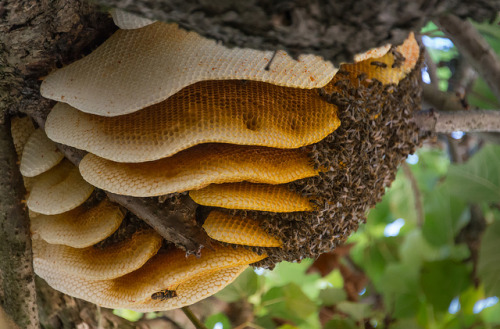
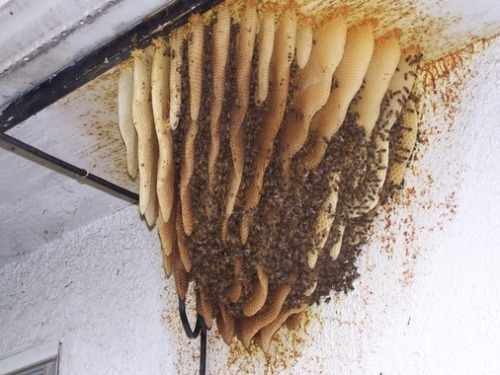
Dwyer Kilcollin’s sculptures make me think of the amazing natural forms of wild beehives: