Showing posts with label notes. Show all posts

Saturday, October 10, 2015

Walter Benjamin for my essay


Try to drag your brain through this:

Selected excerpts from 'The Work of Art in the Age ofMechanical Reproduction' by Walter Benjamin


In the case of the art object, a most sensitive nucleus - namely, its authenticity - is interfered with whereas no natural object is vulnerable on that score. The authenticity of a thing is the essence of all that is transmissible from its beginning, ranging from its substantive duration to its testimony to the history which it has experienced. Since the historical testimony rests on the authenticity, the former, too, is jeopardized by reproduction when substantive duration ceases to matter. And what is really jeopardized when the historical testimony is affected is the authority of the object.
One might subsume the eliminated element in the term 'aura' and go on to say: that which withers in the age of mechanical reproduction is the aura of the work of art. This is a symptomatic process whose significance points beyond the realm ofart. One might generalize by saying: the technique of reproduction detaches th.e reproduced object from the domain of tradition. By making many reproductions it substitutes a plurality of copies for a unique existence. And in permitting the reproduction to meet the beholder or listener in his own partIcular sItuatIon, It reactivates the object reproduced. These two processes lead to a tremendous shattering oftradition which is the obverse ofthe contemporary crisis and renewal of mankind. Both processes are intimately connected with the contemporary mass movements. Their most powerful agent is the film. Its socIal SIgnIficance, particularly in its most positive form, is inconceivable without its destructive, cathartic aspect, that is, the liquidation of the traditional value of the cultural heritage.
Originally the contextual integration of art in tradition found its expression in the cult. We know that the earliest art works originated in the service of a ritual - first the magical, then the religious kind. It is significant that the existence of the work of art with reference to its aura is never entirely separated from its ritual function. In other words, the unique value of the 'authentic' work of art has its basis in ritual, the location of its original use value. This ritualistic basis, however remote, is still recognizable as secularized ritual even in the most profane forms of the cult of beauty. The secular cult of beauty, developed during the Renaissance and prevailing for three centuries, clearly showed that ritualistic basis in its decline and the first deep crisis which befell it. With the advent of the first truly revolutionary means of reproduction, photography, simultaneously with the rise of socialism, art sensed the approaching crisis which has become evident a century later. At the time, art reacted with the doctrine ofl'art pour l'art, that is, with a theology ofart. This gave rise to what might be called a negative theology in the form of the idea of 'pure' art, which not only denied any social function of art but also any categorizing by subject matter. (In poetry, Mallarme was the first to take this position.)
...  An analysis of art in the age of mechanical reproduction must do justice to these
relationships, for they lead us to an all-important insight: for the first time in world history, mechanical reproduction emancipates the work of art from its parasitical dependence on ritual. To an ever greater degree the work ofart reproduced becomes the work of art designed for reproducibility. From a photographic negative, for example, one can make any number of prints; to ask for the 'authentic' print makes no sense. But the instant the criterion of authenticity ceases to be applicable to artistic production, the total function of art is reversed. Instead of being based on ritual, it begins to be based on another practice - politics. 


I like Walter Benjamin, but I think he writes his sentences in the most backwards and roundabout ways possible. I have attempted to rephrase the above into simple english I can understand:

Unlike natural objects, the authenticity of art objects is sensitive, and vulnerable to human interference. The ’authenticity’ of an object refers to its entire lifespan, and how it pays testimony to its own history. The ability to reproduce art objects means that the duration of its history no longer matters. Its authenticity is jeopardised, which affects the object’s authority.
Mechanical reproduction diminishes the ‘aura’ of a work of art. This is a symptom of processes outside of art. The technique of reproduction detaches the reproduced object from its traditional field. By making many reproductions, a unique existence is substituted by copies. When a copy is encountered, the reproduced object is reactivated. These two processes (ie. making reproductions, and encountering them?) are intrinsically connected with contemporary mass movements. They cause tradition to shatter, coinciding with the ‘contemporary crisis’ and renewal of mankind. The most powerful example of these processes is film. Film has positive social significance, but it is also destructive, as it liquidates the traditional value of cultural heritage.
Artworks originated from a ritual context - first magical, then religious. An artwork and its aura are based on, and never entirely separated from, its original ritual function. Although this basis is remotely evident in the cult of beauty, it declined during the Renaissance. Photography was the first truly revolutionary means of reproduction, which occurred simultaneously with the rise of socialism. Art sensed the approaching crisis, and reacted with French art theology. This idea of ‘pure’ art could be considered negative, as it denied any social function of art.
In the age of mechanical reproduction, analysing art must do justice to these relationships. They show that, for the first time in history, mechanical reproduction emancipates artworks from their dependence on ritual. Works of art become increasingly designed to be reproduced. For example, one can make any number of prints from a photographic negative, and there is no one ‘authentic’ print. But when ‘authenticity’ no longer applies to artistic production, the function of art is reversed. Instead of being based on ritual, it becomes political. 

I want to reference his ideas about the effect of mechanical reproduction in my essay, but I'm already well over my word count... I also want to connect his comments about the 'aura' to Nate Larson's works which capture the electric field - or 'aura' - around an object (specifically fruit and vegetables in his 'Ingestion' series)

Thursday, October 8, 2015

Another option


These would be printed on vinyl stickers like the boxes and cut out around the edges. The idea is to depict food packaging - no actual food, but just the containers it comes in - colour coded based on the material, as per the airport customs security scanners. This would bring in ideas of materiality, food waste, consumerism... Also, they wouldn't need to be x-rayed as the vinyl stickers themselves bring in the element of transparency. The images would be photographs of food waste found at elam and at my home. Just another option...

Abstract

Simon Ingram's abstract, used as an exemplar in our 'abstract writing workshop' lecture:


Yet this goes against all of the articles I've read about how to avoid this sort of art jargon. Even after almost 4 years of art education I still can't bring myself to fully buy into this language which, for people who aren't art academics, turns contemporary art into a big joke ('International Art English') This sort of language is easy to scorn and ridicule... but it's also easy to find yourself using it, however much you try to avoid it. 'Like Orwell’s Newspeak... as an in-joke, a private language, a posture, or maybe out of fear – to maintain some questionable status among equally questionable peers' (eye magazine)

Is it possible to strike a balance here? To write about your art in a way that absolutely anyone can read and understand (without needing an art education to be able to decode it), while also using language that is intellectual enough to impress art academics?

This article has been hanging up in the printmaking room all year, and I think it sums up the issues and solutions clearly: 'Writing an artist statement? First ask yourself these four questions" (the guardian)

For our abstracts, we've been asked to answer a very different set of four questions:
-What sort of things do you make?
-What sits in the field you identify with?
-Is your field an established one or did you have to invent it?
-How does what you do represent a different way of working within your field?

Wednesday, October 7, 2015

Documentation: A catch up post / series of unfortunate events (October)

It's been a while since I posted any documentation. This is not because I haven't been doing work - quite the opposite. I've been working so much I haven't had time to document anything properly.
It has been an absolute nightmare few weeks. Bear with me here. There is a happy ending, I promise.
However, the number of times I have gone home in tears is actually embarrassing. So is the number of days when I spent more than 12 hours working solidly at elam.
Now that all the stress is behind me, though, I think it was worth it...

As mentioned in my last post (which seems nightmarish enough, but it just gets worse from there, so much worse…) when I removed the roller bar, the rubber belt got slack and rubbed against the bolts at the back.

The back of the conveyor, roller bar visible
I figured I'd just sort this issue out later, and just get started straightaway, as I anticipated it was going to take ages so I was in a hurry to get printing. And then, when I took off the vinyl test layer, to my horror, it left residue all over the rubber, and I spent a full day scrubbing it off.

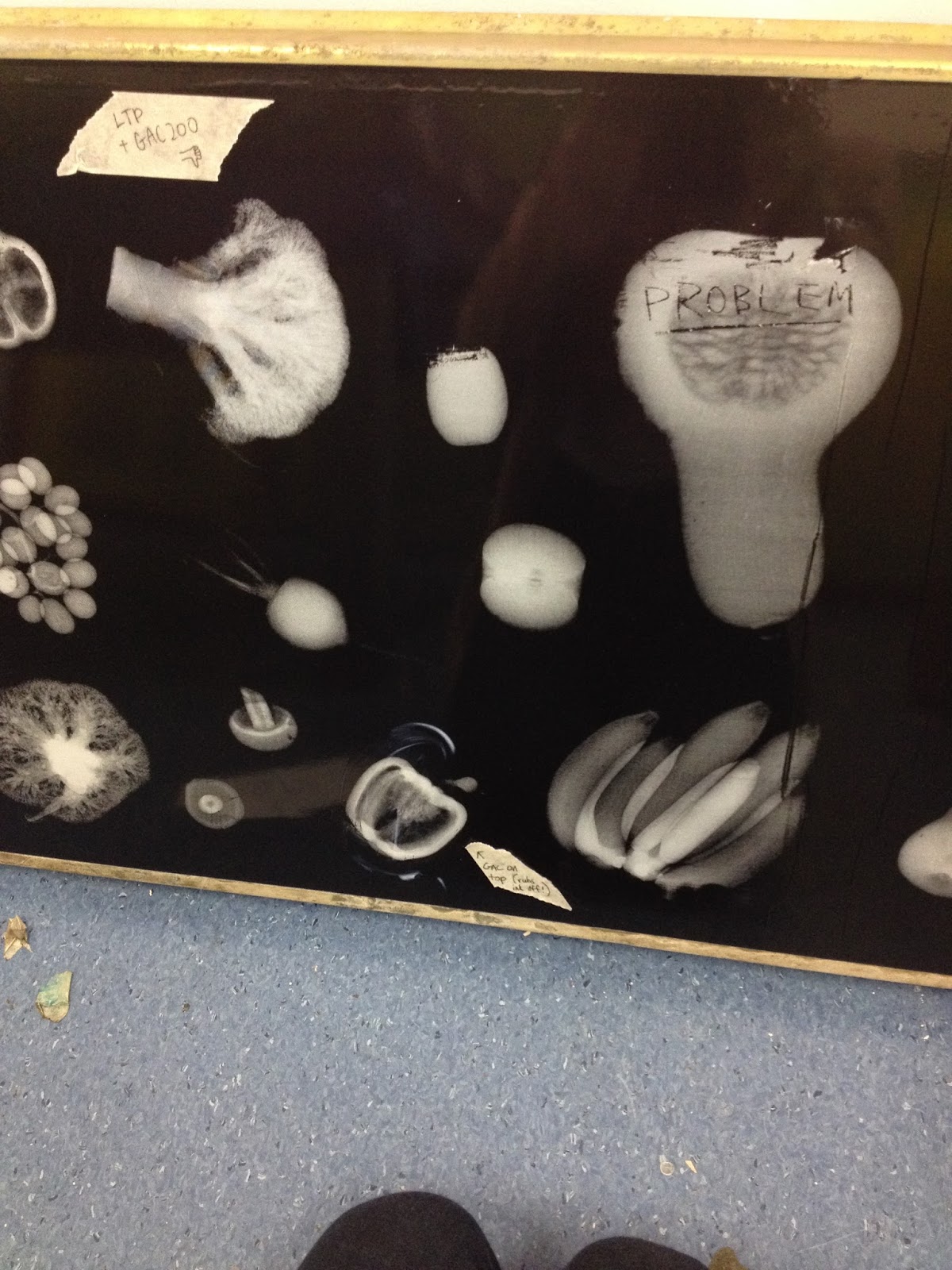
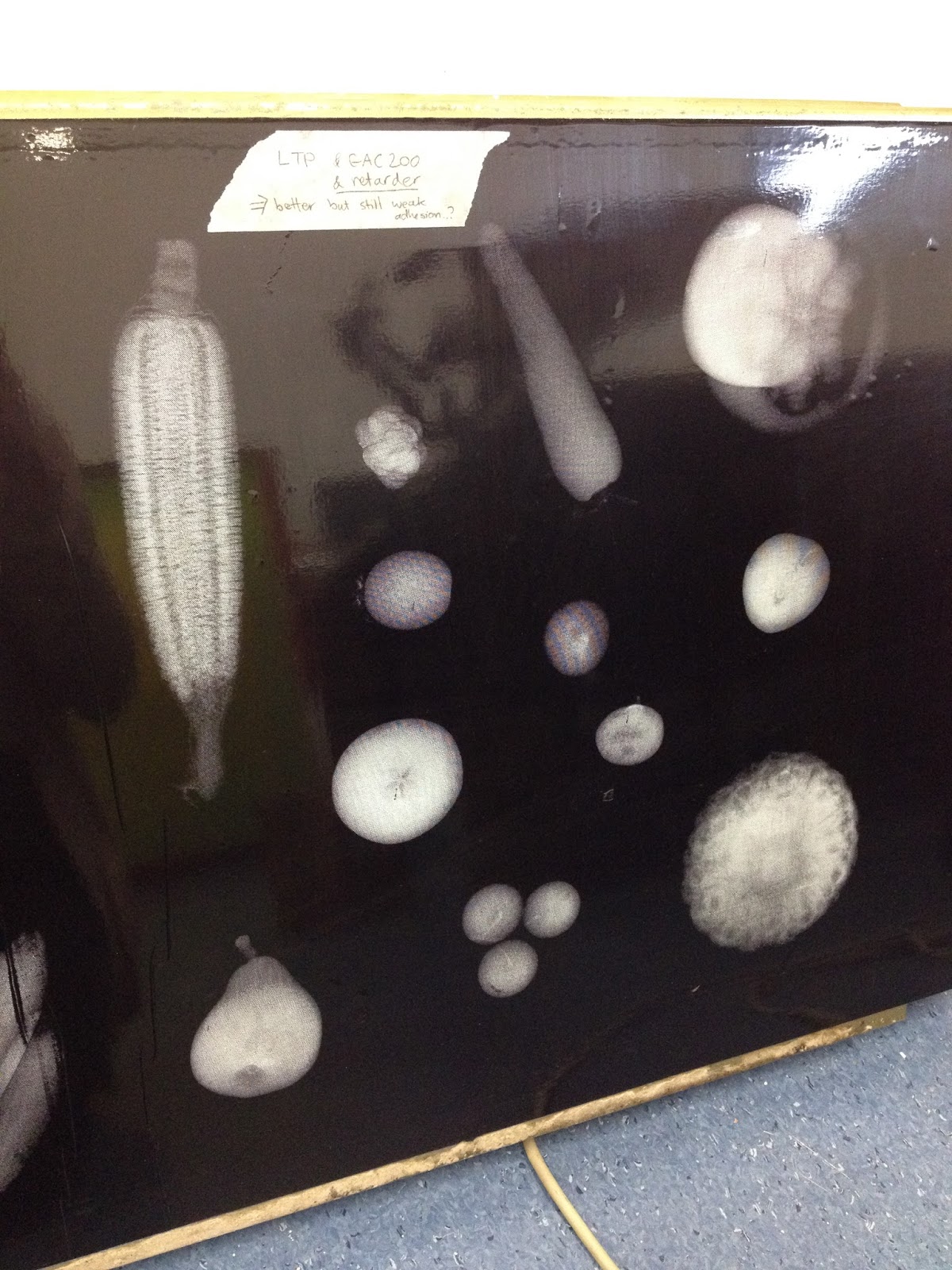
Then I began printing directly onto the rubber itself. It worked okay, would still scratch off when rubbed with a fingernail, so I did a few test patches with different gac / gel mediums mixed with the ink to improve adhesion. It seemed to work better with just the ink, and no additives.
To protect the prints from getting damaged during transit / handling / operation, I wanted to glaze them with some sort of clear plastic coat. I did a few test patches on the blank rubber and the one that worked best was a mixture of Gac 200 and some self levelling clear gel.
However, when I painted this over the prints, they dissolved. I had to scrub off the prints on the first conveyor belt and start over. Again.
So very depressing.

The next week, Ellen and I sussed out a way to seal the prints without this disintegration happening: using spray varnish and waiting for it to dry before applying the medium mixture. This became a very time consuming process as the varnish needed 24 hours to dry, and I could print the conveyors only 1/3rd at a time, with prepping and printing the screens took at least a day, plus drying time of the prints and the medium, so it took over a week to do the first two… It felt worth it, as I was so happy with the depth created by the wonderful sturdy layer of plastic-y varnish.

(The bits of masking tape at the bottom are markers)


Until it leaned against a chair leg overnight and stuck, ripping up a chunk of the medium as well as the print underneath. And then, horror of horrors, the same thing happened with some glad wrap that had been on the ground and got stuck to it, ripping off a whole section of the glaze/print as I carefully peeled it off. And then, once a finished/glazed conveyor had had a full week to dry, I put the roller bar back in, left it overnight, and realised that this was never going to work.
How silly to think I could apply a layer that was both a) adhesive enough to stick to the rubber, and b) not adhesive enough to stick to anything else. Um. Can't really have both.

a distinct indented line was left wherever the roller stopped...


Even without the roller, the belt would make contact with the bolts on the other side, which would cause same problem elsewhere.

Basically, I was not even back to square one, I was ten steps behind where I started.
Getting the varnish off all the prints so far took many days of hard labour, several metres of brillo pads, some paint stripper and a bottle of turps. Nothing could be more demoralising than having to put in this much effort to scrub off your art just to start over again. My blood, sweat and tears went into this artwork. Literally.

removal in progress - bottom left corner.

So, two weeks of intensely hard work wasted; physically and emotionally exhausted; and after having massacred my brain cells from the fumes (I wore a proper respirator mask while using paint stripper, but I'm still paranoid about those toxic fumes) - I started again.
Pete, the metal workshop technician, said I should cover up the roller with soft tape, but I decided to remove the roller altogether, and print onto the rubber using no other media. This was a reluctant defeat. I'd liked the conceptual connections, with the spray varnish linking to the 'dip spray' treatment of imported produce, the gel coat relating to petroleum based wax some fruits are coated with in order to 'maintain freshness' etc. Instead, the list of materials would now read, simply, 'ink on conveyor.''
This way doesn't have quite the same depth but is much more simple, and means it will be easy to re-do any prints should they get damaged in transit from one building to another, etc - rather than having to strip the glaze off and patch it up again, which I’d realised would never work. Sure, without the roller the edges will rub against the bolts at the back, but without the glaze, this damage won’t be evident, as long as the prints themselves are well clear of the edges.

So I got printing... Again.

more masking tape markers
And third time's the charm.


Each conveyor contains about 13 prints, over around 7 screens. Many of the prints needed to be cleaned off straightaway and done two or three times because of blemishes or streaks.
Each screen takes at least a couple of hours prep time - and things occasionally go wrong while water blasting, right at the end, and the process needs to start over.
Considering these hours that went into prepping the screens, it felt like a waste to clean them off again straight away. So I tripled my workload by doing some prints on paper  - white on black, and coloured on white - before cleaning the screens for the next rotation of prints.


Prints on paper
All up it was an extraordinarily long process, but it became enjoyable when it was working (finally!) and I was in the swing of it. I finally finished last Friday and didn't know what to do with myself!!! Full images of the paper prints (above) are to come. I'm still keen to do some different colour combinations, although this would require re-doing the screens all over again.

Of course, with our essay drafts due a while ago, I've been working on my essay at the same time as all of the above. The silver lining of the whole horrendous process I've just described is that it inspired me to come up with the analogy between screen printing and agriculture. Now I know full well how a farmer would feel over a failed crop, and why they would turn to resorts like pesticides, chemical fertilisers etc. if the situation called for it. I would usually never use toxic chemicals like turps and paint stripper, but desperate times do indeed call for desperate measures!

And I have also been busy in the metal workshop, making...
-legs for the white conveyor belt;
-new brackets for the black ones, which I redesigned after my visiting artist crit because I thought other method was kind of clunky (and, to continue my streak of bad luck, I had to go back to the steel shop because someone stole the metal i’d bought a few weeks earlier!!)
-brackets for the sensors

hard at work
And now that the black ones are done, I've been thinking hard about what to print on the white conveyor belt. Screen printing won't be possible on these due to the textured surface and the roller bars underneath which are not removable, but the vinyl stickers I have printed seem to work fine. But do I really want to print more fruit, or found fruit/veg boxes, onto this? I've got a few other ideas... the only issue now is TIME. And not enough of it. One month to go!!

Monday, September 7, 2015

Fruit and Veg X-rays, round 2

I went back to Mercy Radiology again a couple of weeks ago. They loved the bags that I gave them as a thank you for last time, and they are currently getting one of my prints framed for their waiting room. Yay! So I was pretty lucky in that they were more than happy for me to come back again.

This time I brought another massive basket of fruits and vegetables. The ones I've been using so far are getting a bit 'tired' and I felt that it was important to expand my image vocabulary in time for the final installation. We had such a blast, and this time I got to learn a bit more about how the machine works, how they fine-tune the settings, the effects and levels of radiation involved... It was really interesting. And I'm stoked with the images that I came away with...


Printmaking nightmares

Following on from my troubleshooting with printing on adhesive surfaces...

I had a bright idea for printing on the conveyor belts. I got some black vinyl to cover them up with. That way, I could print my images on the vinyl, and if anything went wrong (as things often do with screen printing) I could easily peel off the vinyl and do it again.

Sounds easy.

It wasn't.

Two nightmarish weeks of experimentation ensued, and they were definitely not worth the trouble.

Nope, nope, and nope.

Above: CCG inks and Gac 200. This worked OK, it still rubbed off when scratched with enough pressure.

Using Live to Print plant based inks and Gac 200 in an attempt to make them more adhesive to the shiny surface... No such luck. Even when fully dry it did not stick to the surface at all and flaked off with the lightest touch.

50/50 gac to ink ratio, and still it rubbed off with the brush of a finger.

I had the best of intentions to use Live to Print inks, because they are so nice and matte in contrast with the shiny vinyl surface. I even emailed Matthew Lewis, the maker and supplier of these eco-friendly inks, to ask if he had any ideas for how I could make this work. Basically, his reply was that it's never going to work. The Live to Print inks are made for paper. For printing on plastic, you need another type of ink entirely, and no matter how much medium you add plant-based inks won't ever cut the mustard. In the meantime I'd been busily googling solutions, and this website reconfirmed that it was just never going to happen.

Then, deciding that the 'temporary' plastic surface wasn't worth the trouble, I removed the vinyl. Or, I tried to. It resisted coming off, and when it did, it came off in small strips and left a film of extraordinary sticky adhesive. It took six hours of peeling, scrubbing and half a bottle of rubbing alcohol before the surface was back to its original state.

I'm just so glad I used this as an experiment and didn't have to go through the same process with the other four belts, too.

Anyway, now I'm trying to work out a way of removing the roller from the back of the conveyor, because without that bar of steel pressing against the print surface, I won't need to worry quite so much about the durability of the ink. It's just a matter of whether it will still rotate without this tightness. The question then is what can be done about the metal brackets I've made to prop out the base from the wall - without the roller bar, the belt is slack, and rubs against these.

The adventure continues.

Notes from crit with Lisa Reihana:

The feedback I got for this installation was OVERWHELMINGLY positive.
I wanted to use the crit to see if I could get the go-ahead to print my x-ray images on the conveyor belt. They agreed that the 'readymade' isn't my thing, and while the conveyor's presence and movement is effective on its own, within my practice it is definitely more of a blank canvas. Nonetheless it was great to have a chance to show it on its own before starting to print on it.
The petri dishes were a point of much discussion - again, a lot of great feedback, although the OHP definitely isn't necessary in such a light space and conceptually overcomplicates it. Nikau commented that the use of the petri dishes doesn't do justice to the process and effect of printing transparent cross-sections and displaying them in 3D space - i.e. they could be presented in some way that gives them more impact.
The crit opened up a lot of discussion about food and food systems and the myriad topics I'm tackling in this project. I'm thrilled that as soon as the ball gets rolling everybody gets enthusiastic about these ideas and everybody has something to say. Lisa's advice that stuck with me the most was to stop worrying about making the ideas more ambiguous, when I voiced my concern that it might all be 'too obvious.' She said the complete opposite - that when you're dealing with ideas that are important and that you want to be accessible to a public audience, you can make the ideas obvious, and that's okay. Another really comforting thing she said to me was that I don't need to stress about the overwhelming sensation that there's not enough time and there are a thousand other artworks you want to make. We're all acutely aware of our deadline at the end of this year, but as she pointed out, that's not the end of our art practice - we've got the rest of our lives to realise all the other ideas.
Thanks a million Lisa.

Saturday, September 5, 2015

Documentation: in preparation for visiting artist crit

Judy suggested in the middle of the year that I try printing on other surfaces, and that I try to incorporate movement. The idea of a conveyor belt came up in that discussion.

How cool that would be - to print onto a conveyor belt. So I had this grandoise idea, but no idea if, or how, it would ever come to fruition...
Then, the stars aligned. Someone just happened to be selling a supermarket conveyor belt on Trademe. It was cheaper than the other ones listed, some of which were industrial, thousands of dollars, but this one was still quite an investment. I went for it. And I feel really excited about the installation I have in mind for it.

As a test for the visiting crit, I wanted to hang it on the wall, but this poses some problems as it's 50kgs. Hanging it sideways - horizontal - was the original plan. When I emailed the manufacturers (all conveyor belts in NZ are custom made, and the ones I bought have handy ID numbers and it turns out they are still under warranty - awesome) they pointed out that, thanks to the inconvenient force of gravity, if hung sideways the rubber belt would slip down and possibly get damaged. So, vertical it was.
After a lot of discussion with Pete about how the wall mount could be achieved, I set to work. I measured it all up; went to the north shore to buy some steel; learned to cut, drill, bend and weld; and with these newly acquired skills, made a bracket to connect to the back of the conveyor belt and hook over the top of the wall...

Bend it like Beckham

I also had to find a reflector that would work with the sensors that attach to the motor. The manufacturers told me to buy a certain kind, because the maximum range of the sensors depends on which kind of reflector you use. I emailed a few electronic shops and, after receiving a few curt 'no's, finally managed to track one place that had the right kind.

This can be 3 metres max away from the sensor

And the other advice in their email was super exciting. I'd asked whether the electric circuit could be customised so that when switched on the conveyors could be displayed rolling continuously, and whether the speed could be adjusted. They informed me that this would be a terrible idea because the motor would overheat. The way the sensor works, though, is that it only triggers the rotating motion when the reflection is disrupted. Then, it will rotate for about 10 seconds, or until it is disrupted again.
This is because in a supermarket, or other shop, you want the movement of the conveyor to stop as soon as the customer's goods reach the edge by the cashier. So that's where the sensor is placed. When something reaches that point, the movement is halted. When that object is removed, the conveyor moves again... and the next item comes along, breaking the signal, pausing the movement again.

Meaning that the conveyors will be stationary until someone comes close enough, breaking the signal. Just walking past the work will set off the rotating motion. And it will stop moving if you stop and stand in front of it.
A work that is activated by the viewer!! I'm so excited about this.

Thursday, August 27, 2015

Welcome to the World

The following pages are scanned from 'Yes Naturally: how art saves the world'


“How can we humans establish enduring relationships with the world around us, in which not just human beings, but also nonhuman actors, play an active role? After all, with every step we take, with every action we undertake, we come in close contact with our environment; we continuously influence different bodies, cultures, ecosystems. The worldwide food crisis, climate change and the decline in biodiversity as results of capitalist privatisation and the ‘free market’ demonstrate that the social and ecological worlds are inextricably intertwined. Moreover, these recent and urgent phenomena reveal a disproportionate burden. In a world of social and ecological injustice, it is especially the people from lower social classes, ‘developing’ countries and sensitive ecosystems that pay the price for capitalist progress. In some instances their very survival is threatened. Think, for example, how much indigenous knowledge of the beneficial effects of plant species transitioned via an oral tradition for centuries has been lost because the habitats of these plant species have been destroyed. Also, research into the rising suicide rates among Indian farmers indicates that this dramatic phenomenon is rooted in a complex combination of social and economic factors. Among them, the Green Revolution of the 1960s and 1970s - in which traditional organic farming methods were replaced by mechanistic, production-enhancing techniques such as chemical fertilisers and genetically modified crops - is thought to have contributed to the increase in suicides, due to higher costs yet lower yields.

Yes Naturally aims to show us that social justice and ecological justice are inseparably intertwined. This more inclusive take on justice is based on a pragmatic ethos centred on taking responsibility for the consequences of our actions. The dominant ideology of profit seeking and technological process must make way for an engaging aesthetics that promotes care, responsibility and the interactive process.


The discussion about taking socioecological responsibility in regard to our actions is a theme that inspires many social engaged artists. The artists involved in Yes Naturally are, in their own way, working to investigate and expose social and ecological injustices, and - where possible - to restore the disrupted equilibrium. With their work, these artists acknowledge the interrelated nature of socio-ecological realities. They focus on the local within a global context, devoting particular attention to the community and everyday life."

p 137

Wednesday, August 26, 2015

Documentation: petri dish arrangements

Some more compositions…

Banana, separated and stacked alternately, faced in opposing directions so two forms overlap in 3d space:


Just one form on the OHP:


With the projector lens attached…


A few plates on the lightbox


Projected


Each item at full size:


The whole banana divided by 2


Spare petri dishes to make the height even and the smaller forms ‘hover’


All of them stacked together - extremely fragile!! (Would need a way to connect them with glue or a sort of frame…)


Below: each piece divided into 3. This works out perfectly to scale, as the original cross-sections were 5mm thick and the petri dishes are 15mm high. The resulting ‘stretched’ sculpture was 3 times longer than the original piece of fruit, so dividing this into 3 returns them to their original size.
I like the conceptual implications of this process. The process and ethics of CLONING is a topic I’m really fascinated by. (Bananas are all genetically identical.) For me it speaks to the idea of genetic modification to produce higher yields, leading to a product which might be more resistant or bountiful but which perhaps becomes ‘less’ in other ways, perhaps less tasty or nutritious or healthy… There is no winning argument here and no magic solution, it’s always a compromise.


Sunday, August 23, 2015

Documentation: petri dishes (mid-late August)

Step 3, getting the adhesive onto the petri dishes!
I cut out each cross-section by hand and lined them up with the petri dishes using a printed guide underneath. 


There is a technique for applying adhesive vinyl where the image is aligned, then a strip of the backing is either cut or folded, so that a small section of the sticky side holds the image in the right place while the rest is peeled off and stuck down. Needless to say I got a lot of practice after doing this about 70 times over…


The result was fantastic, a huge improvement on the real fruit pieces as you can now actually see through each layer. This was especially effective when it was lit from underneath - displayed on a lightbox. 


I used an old OHP, and love the conceptual connotations this brought into play. As brought up in the cross-group crit, combined with the old school projector the work begins to reference education, nostalgia, tacky ‘eat your 5+ a day’ posters, science fair projects, museum displays for kids - ‘making science fun!’ - such as ‘weird and wonderful’ section.
You can see it clearly with the OHP light off:


I displayed the banana divided into two so that it was exactly the same height as the elongated tomato and kiwifruit.
The problems addressed in our discussion were
-Jon thinks the petri dishes might be ‘too obvious’ a reference to the world of science - perhaps just the technique of dissecting them or mapping them out could be enough
-It was also mentioned that the usual function of a petri dish is for things to be grown inside it, and using them to present something preserved or static could be problematic as it makes them a display object instead. 
--Ardit prefers the use of real fruit because he says he wants to see it decompose etc. 
…I’m afraid this last comment was water off a duck’s back, however. I’m not interested in using fruit and veg themselves as materials - perishable artworks that smell bad after a few days are just not my jam. What I’m interested in are representations of food, deconstructed and reconstructed and, yes, in the process, preserved. I get excited about the 3d becoming digital image becoming sculptural again, and different techniques for doing this - that element of translation between media, between worlds. I want my work to be about genetic modification, the idea of the synthetic, resulting from scientific interference with nature. Printmaking, in a broad sense, addresses this, in a way that ‘just using the thing itself’ does not. To me that seems like the cheap way out even if it is very ‘elam’. Sorry, not sorry.
-the banana being divided by two into 2x to-scale objects while the other two were stretched out. When this was explained the responses were mixed. It seems the idea of dividing each one into multiples was exciting, but this way of presenting it was perhaps a bit confusing. There is a good opportunity to play around with different arrangements here.


Something that wasn’t brought up but which really bugged me was the fact that despite my best efforts I didn’t quite get the banana to line up correctly - it looks a bit disjointed. Perhaps I’ll have to make another trip to V3.