Both of these articles use a really interesting digital interface, incorporating the text with images/ videos/ animations/ links. I think this is a fascinating new direction for journalism, turning an article into a more visually immersive and interactive experience.
Fresh food grown in the microgravity environment of space officially is on the menu for the first time for NASA astronauts on the International Space Station. Expedition 44 crew members, including NASA's one-year astronaut Scott Kelly, are ready to sample the fruits of their labor after harvesting a crop of "Outredgeous" red romaine lettuce Monday, Aug. 10, from the Veggie plant growth system on the nation’s orbiting laboratory.
An article by Dr Mark Hyman which addresses the circulation of 'cherry-picking' research and misinformation on the internet, and mediates the polarised argument between paleo and vegan diet followers, attempting to combine the two 'opposed' ways of eating.
As someone who is quick to sing the praises of a sustainable/ethical vegan diet, while still (perhaps hypocritically) enjoying the occasional serving of egg/fish/dairy, and avoiding soy like the plague (unless fermented i.e. tempeh/miso,) I agree with every point this article makes. I only wish he'd also addressed the importance of sprouting grains and legumes before cooking, a point mentioned on this paleo faq.
Looking at the research it is easy to get confused. Vegan diet studies show they help with weight loss, reverse diabetes and lower cholesterol. Paleo diets seem to do the same thing. So should you be shunning animal foods and eating only beans, grains and veggies or should you eat meat and fat without guilt and give up all grains and beans? Essentially, each camp adheres to their diet with near religious fervor. And each can point to studies validating their point of view... Comparing a vegan diet of chips and Coke, bagels and pasta to a paleo diet of healthy veggies and grass fed meat won’t be very helpful, nor would comparing a paleo diet of feedlot meat, bologna and no fresh veggies to a whole foods, low glycemic vegan diet. - Dr Mark Hyman
James Nienhuis, a horticulture professor at the University of Wisconsin, uses the Stanchi painting in his classes to teach about the history of crop breeding.
"It's fun to go to art museums and see the still-life pictures, and see what our vegetables looked like 500 years ago," he told me. In many cases, it's our only chance to peer into the past, since we can't preserve vegetables for hundreds of years.
...if demand can be moderated, then an alternative scenario may be preferred.
Here cereal crops are grown only for human consumption and farm animals are confined to
grazing on pasture or consuming byproducts. This „livestock for resource efficiency‟ scenario
could yield genuine ecosystem benefits but the amount of meat and dairy products available
for consumption will be low....the more of an animal one is prepared to eat, the fewer animals are needed for a
given quantity of meat. Such meat will include both cuts and organs that are low in fat – liver,
kidneys, lean muscle – as well as fattier parts that are processed with added salt to improve
palatability – sausages, mince, burgers and nuggets. This suggests a potential trade off
between resource efficiency and nutritional quality. While simple answers are not possible, what is clear is that an environmentally sustainable
level of meat production will be substantially lower than the norm for high income consumers
today.
One thing is clear: the food system today is unsustainable, whether defined in narrow
environmental terms or more broadly to include socio-economic dimensions. Something needs to be done, as most people acknowledge. There is growing recognition
that a shift towards „sustainable diets‟ is one important approach – although this recognition
is by no means widespread. At this stage however, definitions are multiple and there is no
unanimous agreement of just what such a diet might look like on a plate, as it were. Such a diet may compromise on certain nutritional ideals but it certainly represents a
significant improvement on the quality of the average British diet today. However not
everyone likes compromises. Disagreements are likely to continue as to whether nutritional
guidance should prioritise societal over individual objectives; the needs of people today and
in this country, over generations tomorrow and in other countries; the legitimacy of measures
such as GM and fortification strategies in compensating for deficits; and the relative
importance assigned to non-nutritional determinants of health. Critically, there will be strong
disagreement as to whether people can actually be persuaded to eat like this, and if
persuasion is not possible, what level of coercion (through prices, regulations and so forth)
might be legitimate or effective. Moving beyond a narrow environmental focus, we know far less about the complex
relationship between nutritional objectives, environmental sustainability and our other social
and economic goals. This is partly because most of the work on sustainable diets has been
driven by the environmental agenda – understandably so, in view of the massive
environmental problems we face. However it also reflects the fact that social and economic
objectives are extremely hard to agree upon. For example: food should be affordable, but
does that mean that cheap food is good? Is small scale or large scale production to be
preferred? Is equality an end in itself or can its pursuit stifle innovation? There may well be
synergies between nutritional adequacy, environmental sustainability and certain economic
goals, but there are also likely to be costs and deciding how they should balanced between
the two depends on one‟s ideological position. What is more, some economic benefits are
only likely to ensue if certain changes are made to the workings of the economy – and there
will be disagreements as to how far that is possible. Finally, this chapter has been as much about values as about „science.‟ While scientific
knowledge – including in the fields of nutrition and the environment - may be important, the
meaning people assign to its insights will be influenced by beliefs about what is right and
wrong, about how the world works and how it ought to work. Any discussion of sustainability
and which we should go, has to take into account, and explore, the values that stakeholders
bring to the debate.
The issue du jour, it seems, is food waste. How ridiculous that households are encouraged not to let a scrap go to waste, when many big corporations are throwing out tonnes of perfectly good food every day and many even going so far as to lock their bins.
It's the same irony that sees some of us riding bicycles to save petrol when companies are opening new airlines and oil drills; that discourages us from taking long showers or leaving the tap on while we brush our teeth when households use only a fraction of the water used for animal agriculture. (Here and here.)
France is a step ahead, as I've written about earlier (the clever ugly produce marketing) and as this recent article investigates. 'French supermarkets will be banned from throwing away or destroying unsold food and must instead donate it to charities or for animal feed, under a law set to crack down on food waste.' Here's hoping that New Zealand follows suit and introduces similar policies. This article lists some companies' policies on food waste… shame it doesn't mention the bakery where I used to work, which sold on half its leftovers to pig farms, and put the other half into locked skips, filmed on camera so that they could be sure no one was getting their products for free. Name em and shame em, I say. Pandoro Bakery, sort your shit out!
When I was living in France in 2013 not a single scrap of food from our household would go to waste. Even if there were just two bites of a salad or stew left, they would go in a container in the fridge - never the bin - and someone would make sure to eat them the next day. The last resort was the compost bin, and the compost went into the prolific vegetable garden. This philosophy has become second nature for me and I'm still horrified when I see friends and family here in NZ tipping uneaten leftovers into the bin - that would have gotten me scolded by my French host family. Then I remember the restaurants, cafes and supermarkets that are doing this on a much larger scale on a daily basis.
I'm not sure what this has to do with my art. Still working that one out. Something analogous, food = materiality, personal responsibility being dwarfed by corporate interests, like the one little artist's eco-friendly art practice up against the multitudes of massive companies using toxic chemicals by the tonne. I don't know. Yet.
But this technique for picturing food is not a recent revelation born out of Tumblr or Instagram. In 1960, Swiss artist Daniel Spoerri constructed his first snare pictures: assemblages of objects like plates, coffee cups and ashtrays glued on to tables from restaurants and domestic spaces, recreating the exact arrangement of how the items were found. Spoerri, who identifies as a “paster of found situations,” sources these assemblages from specific and personal instances. For example, when his girlfriend Kichka left her breakfast dishes and dregs in the kitchen one morning, Spoerri attached the readymade composition of leftover eggshells, coffee pots and cigarette butts to a wood panel and titled it Kichka’s Breakfast I.
In this process, Spoerri turns meal into memory. When Spoerri installs his work, he attaches it to the wall, facing outward. These foreshortened, wall-bound objects read as rectangles, inviting the audience to approach the pieces as two-dimensional surfaces rather than as sculptures. Spoerri’s snare pictures challenged the conventions of traditional still-lifes, notable in oeuvres ranging from Jean-Baptiste-Siméon Chardin’s to Wayne Thiebaud’s, long before the advent of the Internet.
...
These one-trick ponies are the dispensable images that inundate our contemporary visual culture and cloud our understanding of the nuanced difference between an aesthetically pleasing picture and a compelling photograph.
...
If we, as photographers or viewers, assume the point-of-view of God (or the Cloud, whichever operates at the center of your personal belief system), we expose our own buried desire to have complete control over the food we consume.
....we are programmed to be enchanted by an aerial viewpoint that perceptually flatters our innermost ambition to be omnipotent.
Jon Entine in Forbes: "Seralini's research is anomalous. Previous peer-reviewed rat feeding studies using the same products (NK603 and Roundup) have not found any negative food safety impacts. The Japanese Department of Environmental Health and Toxicology released a 52-week feeding study of GM soybeans in 2007, finding "no apparent adverse effect in rats." In 2012, a team of scientists at the University of Nottingham School of Biosciences released a review of 12 long-term studies (up to two years) and 12 multi-generational studies (up to 5 generations) of GM foods, concluding there is no evidence of health hazards."[74]Andrew Revkin dubbed it another instance of "single-study syndrome", and contended that the study was in support of an "agenda"
Yes, it could be sensationalism. But if there are so many flaws in this research, as its sceptics are quick to point out, why haven't there been more studies like this?
Between 1992 and 2002—the period over which GMO crops moved rapidly from test plants to farm fields to dinner tables, the USDA spent about $1.8 billion on ag-biotechnology research—of which about 1 percent went to safety testing, a Union of Concerned Scientists analysis shows. Meanwhile, the ag-biotech industry uses its patent power to maintain tight control over who researches what—and dominates the research agenda at America's main ag-research universities. When we eat GMOs, as millions of Americans do every day, we're still eating in the dark. The French study didn't fully illuminate the situation, but it's a start.
Why Men Are Afraid of Going Vegan: "Refusing meat in our culture is never simply about just refusing a product… It’s about refusing everything it represents."
Millenials: A food obsessed generation "Millennials – those of us born between 1982 and 2004 – seem to be driven by the intense social media activity surrounding food, and continue to search for a better or more unique food experience than our peers."
So how do nuts stack up to meats? When comparing the global average water footprints, nuts overall have a far lower water footprint when looking at per ton and calorie rates, especially when compared with beef, according to a report on the water footprint of animal products which you can download in full here. Replacing all meat by an equivalent amount of crop products such as pulses and nuts will result in a 30% reduction of the food-related water footprint of the average American citizen,“ water experts and authors of the report, Mesfin Mekonnen and Arjen Hoekstra say.
The Great Easter Bunny Hunt is an annual event for Central Otago, organised by the Alexandra Lions Club. Now in its 24th year, the Easter cull was hatched as a way to help out farmers - New Zealand Herald
A media repeat of the Hell’s Rabbit Pizza billboard around this time last year (which was accompanied by posters reading ‘Lost - pet bunny’ and ‘Found bunny rabbit - was delicious’)
I’m fascinated by the complicated way we see rabbits. A pest? A pet? A food? No other animal I can think of falls so perfectly within all of those categories.
Intermarché launched Inglorious Fruits and Vegetables to highlight the absurdity of throwing away perfectly edible produce due because they don’t look ‘perfect.’
GERMANY - On a recent visit to the University of Leipzig to review the latest research there, the agriculture minister has called for a practical method to determine the sex of chicken embryos in order to bring to an end the culling of male layer chicks by the end of 2016. Mr Schmidt said that, by the end of 2016, there should be prototypes of a device that determines the sex of chicken embryos at just three days of incubation and then sorts the eggs automatically by gender. He added that, when such a device is available on the market, there will be no need for the nation’s hatcheries to kill male chicks, a practice that will soon belong in the past.
The Government has relented to a campaign to ban animal trials for the second time in a year, this time within the cosmetics industry. - New Zealand Herald
Food campaigner and former Green MP Sue Kedgley says the fact ethical products are now everywhere on supermarket shelves shows the market is changing but the amount is still up to shoppers.“Vote with your wallet, vote with your fork. Whenever you buy something you can be sending a message to food producers about the sort of food you want to buy.”
This study shows that sperm count is almost halved in men who eat produce containing pesticide residue.
“Strawberries, apples, pears, peppers and spinach are just some of the crops which are intensively sprayed by farmers to eradicate pests and boost production.”
“Previous studies have shown a link between sperm counts and pesticides for agricultural workers or men living near farmland, but the research is the first to find a link the problem to diet.”
(yesterday, March 31, in an article by Sarah Knapton, Science Editor of the Telegraph.)
Interesting! Mankind is literally killing itself off with our own poison.
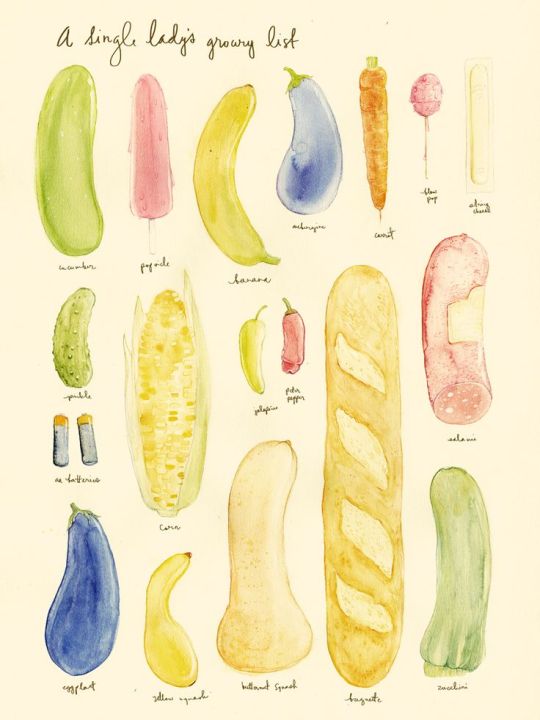
This reminded me of this phallic illustration by Monica Ramos, “A Single Lady’s Grocery List”:
Environmentalists warn us that apocalypse awaits. Economists tell us that minimal fixes will get us through. Here’s how we can move beyond the impasse.